RTT Hypnotic Language Explained for Personal Healing


TL;DR:
RTT hypnotic language uses specific linguistic patterns to rapidly access the subconscious mind for therapeutic change. It employs techniques like embedded suggestions, presuppositions, and sensory language to reframe limiting beliefs at their root. Post-session recordings reinforce new neural pathways and are essential for lasting transformation.
RTT hypnotic language is defined as a specialized use of linguistic patterns that guide the subconscious mind toward rapid therapeutic change. Rapid Transformational Therapy, developed by Marisa Peer, integrates this language approach with hypnosis, psychotherapy, NLP, and CBT to produce results within 1–3 sessions. The core mechanisms include embedded suggestions, presuppositions, and pacing and leading. Understanding how these patterns work gives you a clearer picture of why RTT produces change so quickly, and why the language used in sessions is anything but accidental.
What are the core hypnotic language techniques used in RTT?
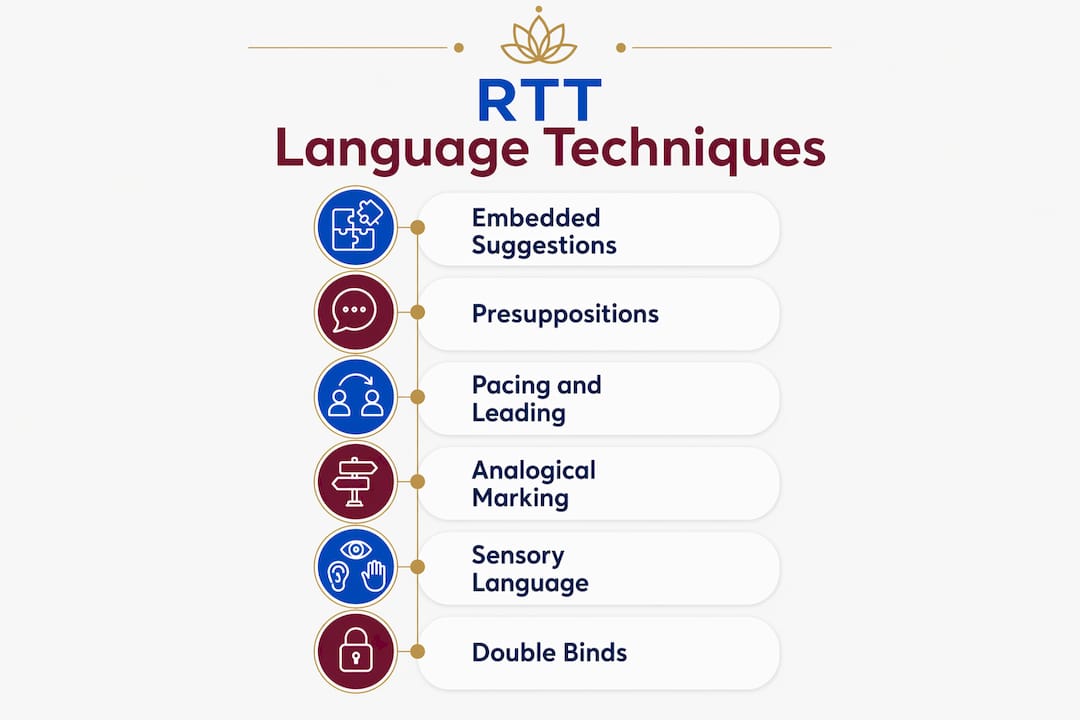
Hypnotic language in RTT uses six core mechanisms to influence the subconscious mind. Each one operates differently, but all share the same goal: to slip past the critical, analytical part of your mind and speak directly to the part that holds your beliefs, habits, and emotional responses.
Embedded suggestions are commands hidden inside longer sentences. Instead of saying “relax now,” a therapist might say “you may find that, as you listen, your body begins to relax.” The command “relax” lands without triggering resistance.
Presuppositions assume a desired outcome is already true. “When you feel more confident” presupposes confidence is coming. Your mind accepts the frame without debating it.
Pacing and leading starts by matching your current experience, then gently directing you toward a new one. A therapist might say “you’re sitting here, breathing slowly, and as you do, a sense of calm begins to build.” The first part is undeniably true, which makes the second part easier to accept.
Ambiguity uses words or phrases with more than one meaning. This keeps the conscious mind busy trying to interpret, while the subconscious picks the meaning that fits best. The phrase “you can let go” works on multiple levels at once.
Sensory language activates internal imagery. Words like “warm,” “heavy,” “bright,” or “clear” trigger physical and emotional responses. Sensory language pulls the mind into an experience rather than just describing one.
Double binds offer two choices that both lead to the same outcome. “You can close your eyes now, or in a moment” gives the feeling of choice while both options move you toward the same state.
Pro Tip: When you listen to a hypnotherapy recording, notice when a sentence feels like it is describing your current state before it shifts to something new. That shift is pacing and leading in action.
These six techniques are not random. They are drawn from the Milton Model, a framework developed by Richard Bandler and John Grinder based on the language patterns of psychiatrist Milton H. Erickson. RTT applies these patterns with a specific therapeutic intent: to locate and reframe the root cause of a limiting belief, not just manage its symptoms.
How does hypnotic language function within the RTT therapy process?
RTT sessions are structured to use hypnotic language at every stage, not just during the trance itself. A typical session lasts 90–120 minutes and moves through four distinct phases.
Pre-talk and rapport building. The therapist uses pacing language to match your current emotional state and establish trust. This phase sets the receptive tone for everything that follows.
Induction and deepening. Guided by sensory language and embedded suggestions, you enter a relaxed, focused state. This is not unconsciousness. It is a state of heightened inner attention where the subconscious becomes more accessible.
Regression and reframing. The therapist uses presuppositions and leading language to guide you back to the origin of a belief. Once located, hypnotic language reframes that belief at the subconscious level. This is where the core therapeutic work happens.
Transformation and close. The session ends with direct positive suggestions and a personalized script that reinforces the new belief. This script becomes the basis for your post-session audio recording.
The neuroscience behind this process centers on neuroplasticity, the brain’s ability to form new neural pathways in response to repeated input. Hypnotic language delivered during trance reaches the subconscious in a state of reduced critical filtering. That makes the new beliefs easier to install. But installation is not the same as consolidation.
Pro Tip: Treat your post-session audio recording like a prescription, not a bonus. The language in that recording is calibrated specifically to your session. Skipping it is like stopping antibiotics after two days.

Listening to bespoke audio recordings daily for 10–21 days is the step that cements new neural pathways. The session opens the door. The recordings walk you through it repeatedly until the new pattern becomes automatic. This is why RTT practitioners emphasize post-session commitment as much as the session itself.
What makes RTT hypnotic language different from other therapy language?
The clearest distinction is intentional vagueness. Most therapeutic approaches use precise, direct language to help clients analyze and understand their experiences. RTT’s hypnotic language does the opposite on purpose.
The Milton Model employs vague language patterns to bypass the critical conscious mind and engage the subconscious directly. When a therapist says “you can begin to notice a change,” the vagueness is the point. Your subconscious fills in what “change” means based on your own internal world. That makes the suggestion feel personal rather than imposed. The transformation feels like it came from inside you, because in a meaningful sense, it did.
This is fundamentally different from how RTT hypnotherapy differs from talking therapy. Talking therapy works primarily through conscious analysis. You examine a belief, understand its origins, and gradually shift your perspective. RTT skips the analytical layer and works directly with the subconscious layer where the belief lives. The language is the tool that makes that access possible.
Effectiveness depends on client receptivity and cooperation. Hypnotic language does not override your will. It works best when you are open to the process and when the suggestions align with your genuine goals. A person who enters a session skeptical but curious will still benefit. A person who is actively resistant will find the language has less traction. This is not a flaw in the method. It reflects how the subconscious actually works: it responds to what you are willing to receive.
RTT also differs from standard hypnotherapy in its solution focus. Traditional hypnosis often uses direct suggestion to suppress a behavior. RTT uses hypnotic language to locate the root cause of a belief, reframe it, and replace it. The language is not just calming. It is diagnostic and reconstructive.
How can RTT hypnotic language support personal development and emotional healing?
Understanding hypnotic suggestions gives you a practical advantage in your own healing process. When you know what these patterns do, you engage with them more fully rather than analyzing them from a distance.
The most direct benefits include:
Overcoming limiting beliefs. Presuppositions and reframing language target beliefs like “I am not good enough” at the subconscious level, where they were formed. Hypnotherapy can change your mindset by replacing those beliefs with ones that serve you.
Reducing anxiety. Pacing and leading language creates a felt sense of safety during sessions. Over time, the nervous system learns to associate that state with calm rather than threat. Hesketherapy uses this approach specifically for clients dealing with anxiety and burnout.
Building confidence. Embedded suggestions and positive presuppositions install new self-referential beliefs. Hypnotherapy for self-confidence works because the language bypasses the self-critical voice that would otherwise reject the new belief.
Processing emotional blocks. Sensory language and regression techniques help clients access and release stored emotional responses that have not responded to conscious effort alone.
Choosing a qualified RTT practitioner matters as much as understanding the method. Look for someone certified through a recognized training body, with experience in the specific area you want to address. Hesketherapy works with English-speaking clients in Madrid and online, specializing in anxiety, burnout, trauma, and sleep issues through RTT and complementary approaches.
The post-session audio recording is where personal development becomes a daily practice. Personalized audio recordings require active daily listening for neural change to consolidate. This is not passive background noise. It is a structured repetition of the hypnotic language from your session, delivered in a state of relaxed focus. Twenty minutes a day for three weeks is a small investment for a belief system that has been running your life for years.
Key takeaways
RTT hypnotic language works because it uses specific linguistic patterns to access the subconscious directly, bypassing conscious resistance and replacing limiting beliefs at their root.
Point | Details |
Six core mechanisms | RTT uses embedded suggestions, presuppositions, pacing and leading, ambiguity, sensory language, and double binds. |
Session structure matters | A 90–120 minute RTT session moves through rapport, induction, regression, reframing, and transformation in sequence. |
Post-session audio is non-negotiable | Daily listening for 10–21 days consolidates new neural pathways formed during the session. |
Vagueness is intentional | Milton Model language bypasses critical filters by letting the subconscious fill in meaning personally. |
Receptivity amplifies results | Hypnotic language works best when the client is open and the suggestions align with genuine personal goals. |
What I have learned about hypnotic language that most articles miss
People come to RTT expecting the language to do something to them. That framing misses the point entirely. The language creates conditions. What happens inside those conditions is yours.
I have worked with clients who spent years in conscious analysis of their anxiety, understanding every trigger, every pattern, every childhood root. They could explain their problem beautifully. The problem did not care. Hypnotic language reaches the part of the mind that stores the emotional charge behind the belief, not just the intellectual description of it. That is a fundamentally different kind of access.
The subtlety that surprises most people is how ordinary good hypnotic language sounds. It does not feel dramatic or mysterious. A well-crafted embedded suggestion sounds like a kind observation. A presupposition sounds like a reasonable assumption. That ordinariness is the whole point. The moment language feels like a technique, the critical mind wakes up and starts evaluating. The best hypnotic communication skills are invisible.
What I tell every client before their first session: the recordings are not optional extras. They are the mechanism. The session is the map. The recordings are the walk. Skipping them is like drawing a map and never leaving the house. The self-hypnosis recordings available through Hesketherapy are built on exactly this principle: consistent, calibrated repetition of language that your subconscious has already been primed to receive.
The art in RTT hypnotic language is not in the complexity of the words. It is in the precision of the timing, the warmth of the delivery, and the therapist’s ability to read what a client needs in that moment. That is not something a script alone can provide. It is why the relationship between therapist and client still matters, even in a method built on language patterns.
— Heske
RTT therapy at Hesketherapy: what to expect
Hesketherapy offers RTT sessions online and in-office in Madrid, designed for English-speaking clients navigating anxiety, burnout, trauma, and emotional blocks. Sessions are conducted in English, Spanish, or Dutch, with personalized post-session audio recordings included as a core part of the process.
Each session is built around your specific history and goals, not a generic script. If you are ready to understand how RTT therapy works in practice and whether it fits what you are dealing with, a free discovery call is the natural first step. You can also book directly online to explore session options, including individual and package formats for both in-person and remote clients.
FAQ
What is RTT hypnotic language?
RTT hypnotic language is a set of linguistic patterns, including embedded suggestions, presuppositions, and sensory language, used to access and guide the subconscious mind during Rapid Transformational Therapy sessions.
How long does an RTT session take?
A standard RTT session lasts 90–120 minutes and includes induction, regression, reframing, and a closing transformation phase using targeted hypnotic language.
Why do RTT practitioners use vague language?
Vague language, drawn from the Milton Model, bypasses the critical conscious mind and allows the subconscious to fill in meaning personally, making suggestions feel internally generated rather than externally imposed.
How important are post-session audio recordings?
Post-session recordings are central to RTT outcomes. Daily listening for 10–21 days consolidates the new neural pathways formed during the session and is the mechanism through which lasting change occurs.
Can RTT hypnotic language help with anxiety and confidence?
RTT hypnotic language directly targets the subconscious beliefs that drive anxiety and low confidence, replacing them through embedded suggestions and reframing rather than conscious analysis alone.
Recommended
Comments