Hypnotherapy Confidence Building Explained for Real Results
- Heske Ottevanger
- Jun 20
- 8 min read


TL;DR:
Hypnotherapy reprograms subconscious beliefs to replace self-doubt with lasting confidence without loss of control. It targets deep-rooted patterns through techniques like suggestion, regression, and visualization during a focused trance state. Structured sessions with active client participation can reduce confidence issues by up to 75% within just a few appointments.
Hypnotherapy confidence building is defined as a therapeutic process that reprograms subconscious belief patterns to replace self-doubt with durable self-assurance, without any loss of conscious control. Unlike positive thinking or willpower-based approaches, this method works at the level where habits and identity narratives actually live. Low confidence is often a learned subconscious pattern, not a fixed character trait, which means it can be systematically unlearned. Techniques like Neuro-Linguistic Programming (NLP) integration, regression, and mental rehearsal make hypnotherapy one of the most direct routes to lasting confidence improvement available today.
How does hypnotherapy build confidence through subconscious pattern change?
Hypnotherapy builds confidence by accessing the subconscious mind during a trance state and replacing limiting beliefs with new, accurate self-perceptions. The subconscious mind governs roughly 95% of your daily behavior, including the automatic thoughts that tell you whether you are capable or not. When you are in a relaxed, focused trance, the critical filter of the conscious mind quiets down. That reduced resistance is what makes the subconscious receptive to new information.

Confidence is a skill rewired by systematically dismantling limiting subconscious identity narratives, regulating the nervous system, and rehearsing small wins mentally. This is not about pasting positive thoughts over negative ones. It is about locating the original belief, understanding where it came from, and neutralizing the emotional charge attached to it.
Therapists use several core techniques to achieve this:
Positive suggestion: Direct statements delivered during trance that the subconscious accepts as true, replacing old scripts like “I am not good enough.”
Regression: Guided return to the memory or experience where a limiting belief first formed, allowing the client to reinterpret it from an adult perspective.
Visualization: Mental imagery during hypnosis activates the same neural pathways as actual experience, making it a powerful tool for subconscious learning of confident behavior.
Anchoring: A physical or mental cue is linked to a resourceful emotional state so the client can access confidence on demand in real life.
NLP integration: Language patterns and reframing techniques are layered into the session to reinforce new beliefs at both conscious and subconscious levels.
Pro Tip: Ask your therapist to record your personalized suggestion track. Listening to it nightly for 21 days accelerates the subconscious rewiring between sessions.
Each technique targets a different layer of the problem. A skilled therapist combines them based on your specific history, not a generic script. That specificity is what separates clinical hypnotherapy from a self-help audio recording.
What are the common myths about hypnosis for confidence?
The biggest barrier between you and hypnotherapy is usually a misconception about what actually happens in the room. Most people picture a swinging watch and someone clucking like a chicken. That image has nothing to do with clinical practice.
Clients remain fully aware and in control during hypnotherapy, experiencing a deeply relaxed but focused state rather than sleep or loss of autonomy. You hear everything. You can speak, move, and end the session at any time. The trance state feels more like the absorbed focus you experience when reading a gripping book than anything resembling unconsciousness.
Here are the most common myths, corrected:
Myth: The therapist controls your mind. Hypnotherapy is collaborative. The therapist guides; you participate. No suggestion takes hold without your subconscious acceptance.
Myth: You will reveal secrets you want to keep. You cannot be made to say or do anything against your values. The critical mind does not disappear entirely.
Myth: It only works on gullible people. Hypnotic receptivity is a normal human capacity. People with strong focus and imagination are often the most responsive.
Myth: One session fixes everything. Confidence grows through repeated small wins supported by hypnotherapy, not by forcing positive thoughts over negative ones. Progress is real but cumulative.
Pro Tip: Before your first session, write down three specific situations where low confidence holds you back. Concrete goals give the therapist a precise target and make sessions far more effective.
Effective hypnotherapy sessions are designed around clear, specific client goals rather than vague desires for “more confidence.” That specificity is what allows the therapist to select the right technique for your exact pattern. Vague intentions produce vague results.
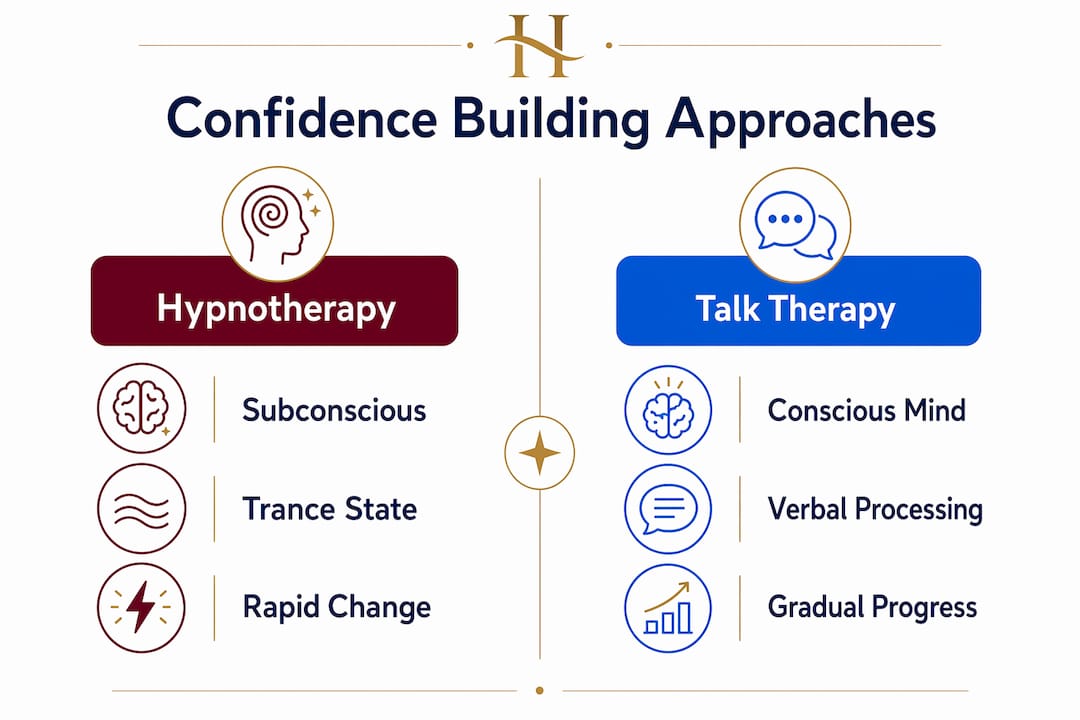
How does hypnotherapy compare to coaching and talk therapy?
Coaching, cognitive behavioral therapy (CBT), and hypnotherapy all aim to improve confidence, but they operate on different levels of the mind. Understanding the difference helps you choose the right tool, or the right combination.
Method | Primary Focus | Depth of Change | Typical Timeline |
Life coaching | Conscious goal setting and accountability | Behavioral | Ongoing, months to years |
CBT | Identifying and challenging conscious thought patterns | Cognitive | 8–20 sessions |
Counseling | Emotional processing and insight | Emotional/relational | Varies widely |
Hypnotherapy | Subconscious belief and nervous system reprogramming | Foundational | 1–6 sessions |
RTT (Rapid Transformational Therapy) | Combined hypnosis, NLP, CBT, and regression | Multi-layered | 1–3 sessions |
Unlike coaching or talk therapy, hypnotherapy works on subconscious patterns, making change more foundational and sustainable. CBT teaches you to argue with a negative thought. Hypnotherapy goes back to where the thought was born and changes the source code.
Hypnotherapy shifts treatment from symptom management to permanent resolution by changing subconscious fight-or-flight triggers, often within 3–5 sessions. That speed is not magic. It reflects the efficiency of working directly with the subconscious rather than trying to override it from the top down.
The strongest results come from multi-layered approaches. Hesketherapy’s RTT method, for example, combines hypnosis with NLP, CBT principles, and regression in a single session framework. That combination addresses the belief, the emotional charge, the nervous system response, and the behavioral habit simultaneously. You can explore how hypnotherapy changes mindset at a subconscious level to understand why this layered approach outperforms single-method treatments.
What to expect in a hypnotherapy session for confidence?
Knowing what happens in a session removes the anxiety of the unknown and helps you show up ready to engage. Here is a realistic breakdown of the process.
Initial consultation. Your therapist gathers your history, identifies the specific confidence challenges you face, and sets measurable session goals. This is not small talk. It is the diagnostic foundation for every technique that follows.
Trance induction. Using breathing, progressive relaxation, or guided imagery, the therapist guides you into a focused, receptive state. Your eyes close. Your body relaxes. Your mind stays alert.
Targeted suggestion and regression. The therapist delivers personalized suggestions aligned with your stated goals. If a past experience is driving current self-doubt, regression techniques revisit and reframe it. Mental rehearsal under hypnosis acts as a flight simulator for the nervous system, creating templates of success that ease real-life performance anxiety.
Anchoring and integration. A resource state, such as a feeling of calm authority, is anchored to a physical cue you can use outside the session.
Homework and self-hypnosis. The most effective hypnotherapy is collaborative, requiring clear articulated goals and active engagement, including homework exercises. Your therapist may provide a personalized audio recording for daily listening, or assign small behavioral challenges to stack real-world evidence of your growing capability.
A common pitfall is confusing confidence issues with underlying trauma or anxiety that requires tailored interventions such as regression or parts integration. If your low confidence is rooted in a traumatic experience, standard suggestion-based hypnotherapy is not enough. A qualified therapist identifies this in the consultation and adjusts the approach accordingly.
Targeted interventions combining hypnotherapy with NLP can reduce specific anxieties by up to 75% in as few as 1–4 sessions. That figure reflects structured, goal-directed work, not passive relaxation. Your active participation determines how quickly those results arrive.
Pro Tip: Between sessions, practice the self-hypnosis recording your therapist provides AND take one small action that your old self would have avoided. The combination of subconscious rehearsal and real-world evidence is what makes the change stick.
For a practical companion to your sessions, Hesketherapy’s confidence meditation is a guided audio tool designed to reinforce subconscious shifts between appointments.
Key Takeaways
Hypnotherapy builds lasting confidence by reprogramming subconscious belief patterns through trance-based techniques, not willpower or positive thinking.
Point | Details |
Subconscious is the target | Hypnotherapy changes beliefs at their source, not just the conscious thoughts sitting on top of them. |
You stay in control | Clients remain fully aware during sessions and cannot be made to act against their values or wishes. |
Speed advantage over talk therapy | Structured hypnotherapy with NLP can reduce specific anxieties by up to 75% in 1–4 sessions. |
Active participation required | Homework, self-hypnosis recordings, and small behavioral wins between sessions drive lasting results. |
Trauma needs tailored work | Confidence rooted in past trauma requires regression or parts integration, not generic suggestion scripts. |
What I have learned from working with confidence in the therapy room
Most people who come to me for confidence work arrive believing they are simply “not a confident person.” That belief is the first thing I address. Confidence is not a personality type. It is a pattern, and patterns can be changed.
What surprises clients most is how quickly they locate the origin of their self-doubt once they are in trance. A throwaway comment from a teacher at age nine. A parent who never said “well done.” A public failure that the subconscious filed under “proof I am not enough.” These moments are not dramatic. They are small, and that is exactly why they slip past conscious awareness and embed themselves so deeply.
The work I find most effective is not about flooding clients with affirmations. It is about going back to that original moment, seeing it accurately from an adult perspective, and removing the emotional charge that has been running the show ever since. Once that charge is gone, the new belief does not need to fight for space. It simply fills the vacuum.
I also want to be honest about what hypnotherapy is not. It is not a passive experience where you lie back and get fixed. The clients who get the best results are the ones who come with specific goals, do their homework, and take small risks in real life between sessions. The trance state opens the door. You still have to walk through it.
If you are dealing with anxiety alongside low confidence, as many of my clients in Madrid do, I recommend exploring clinical hypnotherapy for anxiety as a parallel track. The two issues feed each other, and treating them together accelerates progress on both fronts.
— Heske
Ready to build confidence that actually lasts?
If this article has clarified how hypnotherapy works and you are ready to move from understanding to action, Hesketherapy’s RTT therapy program is designed for exactly this.
RTT (Rapid Transformational Therapy) combines clinical hypnosis, NLP, regression, and CBT principles into a focused session framework that targets the subconscious root of low confidence directly. Hesketherapy works with English-speaking clients in Madrid and online, delivering personalized sessions with measurable outcomes. Most clients see meaningful shifts within 1–3 sessions. Explore the full RTT therapy method and book a free discovery call to find out whether it is the right fit for where you are right now.
FAQ
What is hypnotherapy confidence building?
Hypnotherapy confidence building is a clinical process that uses trance-induced receptivity to replace limiting subconscious beliefs with accurate, empowering self-perceptions. It targets the root cause of low self-esteem rather than managing surface symptoms.
How many sessions does hypnotherapy take to build confidence?
Structured hypnotherapy combined with NLP can reduce specific anxieties and confidence blocks by up to 75% in as few as 1–4 sessions. The exact number depends on whether underlying trauma is present and how actively the client engages between appointments.
Is self-hypnosis effective for building confidence at home?
Self-hypnosis recordings personalized to your goals reinforce subconscious shifts between professional sessions and are a standard part of effective hypnotherapy programs. They work best when paired with small real-world behavioral challenges that build evidence of capability.
How is hypnotherapy different from CBT for confidence?
CBT teaches you to identify and challenge negative conscious thoughts, while hypnotherapy works directly on the subconscious patterns that generate those thoughts in the first place. Hypnotherapy reaches deeper and often produces faster results for confidence issues rooted in early experiences.
Can hypnotherapy help if my low confidence is linked to anxiety?
Yes. Hypnotherapy addresses both the subconscious triggers of anxiety and the limiting beliefs that feed low confidence, making it particularly effective when the two issues overlap. A qualified therapist will assess whether regression or nervous system regulation techniques are needed alongside standard confidence work.
Recommended
Comments