List of Therapy Approaches: Your 2026 Decision Guide


TL;DR:
Different therapy approaches include CBT, DBT, EMDR, ACT, and psychodynamic therapy, each targeting specific mental health issues. Choosing the right method depends on your challenge, but a strong therapeutic relationship often predicts better outcomes than technique alone. Integrative therapy combining multiple modalities and verifying therapist credentials improves the chances of effective treatment.
A therapy approach is a structured method used by mental health professionals to guide treatment and support people facing psychological challenges. The list of therapy approaches available today includes CBT, DBT, EMDR, ACT, and psychodynamic therapy, each with distinct principles, session structures, and target conditions. Choosing the right method depends on your specific challenge: best therapy choice aligns CBT with anxiety, DBT with emotional dysregulation, and ACT with chronic stress. Understanding your options before speaking with a therapist puts you in a far stronger position to get the right help faster.

1. What is the list of therapy approaches used most often?
Psychotherapy methods fall into several well-researched categories. The most widely applied include Cognitive Behavioral Therapy (CBT), Dialectical Behavior Therapy (DBT), Eye Movement Desensitization and Reprocessing (EMDR), Acceptance and Commitment Therapy (ACT), and psychodynamic therapy. Each targets a different layer of mental health: thoughts, emotions, trauma memory, values, or unconscious patterns. Knowing what each one does helps you ask better questions when you meet a therapist.
These are not interchangeable tools. CBT works on present-day thinking patterns. EMDR processes stored trauma. Psychodynamic therapy uncovers the roots of long-standing behavior. Matching the method to the problem is what separates effective treatment from years of slow progress.
2. Cognitive behavioral therapy (CBT): the most widely used approach
CBT focuses on changing negative thought and behavior patterns and is effective for anxiety, phobias, depression, and OCD. It is present-focused, meaning sessions deal with what is happening now rather than excavating childhood history. A typical CBT program runs 12–20 weekly sessions, each lasting 50–60 minutes. The therapist and client work together to identify distorted thinking, test those thoughts against reality, and replace them with more accurate ones.
CBT is the most researched psychotherapy method in existence. Its evidence base covers anxiety disorders, burnout, post-traumatic stress, and chronic pain. For people dealing with work-related stress or persistent worry, it delivers measurable results within a few months.
Conditions treated: generalized anxiety, social anxiety, depression, OCD, PTSD, phobias
Session structure: weekly individual sessions, homework assignments between sessions
Duration: typically 12–20 sessions
Core technique: cognitive restructuring and behavioral experiments
Pro Tip: Before your first CBT session, write down three recurring thoughts that cause you distress. Bringing concrete examples speeds up the early phase of treatment significantly.
3. Dialectical behavior therapy (DBT) and its specialized role
DBT is a form of CBT that balances acceptance and change. It was originally developed for borderline personality disorder but now applies broadly to anyone struggling with intense emotional reactions, self-harm behaviors, or unstable relationships. DBT builds skills in four core areas: mindfulness, distress tolerance, emotion regulation, and interpersonal effectiveness.
What makes DBT structurally different from standard CBT is its dual-format delivery. Clients attend both individual therapy sessions and group skills training. The group component teaches practical techniques for managing overwhelming emotions in real time. This combination makes DBT particularly effective for people who feel that standard talk therapy has not been enough.
DBT’s four skill modules address:
Mindfulness: staying present without judgment
Distress tolerance: surviving emotional crises without making them worse
Emotion regulation: understanding and shifting intense feelings
Interpersonal effectiveness: communicating needs clearly while maintaining relationships
For people who describe their emotional experience as “all or nothing,” DBT provides a structured path toward balance. It is one of the few psychotherapy techniques overview studies consistently rank as effective for chronic suicidal ideation and self-harm.
4. How EMDR works for trauma recovery
EMDR stands for Eye Movement Desensitization and Reprocessing. It uses bilateral stimulation, typically guided eye movements, while a person recalls a traumatic memory. This process helps the brain reprocess the memory so it no longer triggers the same intense emotional response. EMDR is highly effective for trauma, with 84–90% of single-trauma victims improving significantly after about three 90-minute sessions. That success rate is striking compared to most other trauma treatments.
EMDR sessions typically run 90 minutes, longer than standard therapy hours. The extended time allows a full processing cycle within a single session rather than stopping mid-memory. Clients often report significant symptom reduction after just a few sessions, which makes EMDR one of the fastest-acting trauma therapies available.
Pro Tip: EMDR requires advanced certification. Before booking, ask your therapist directly whether they hold an EMDR International Association (EMDRIA) credential or equivalent. Therapist training and certification in specialized modalities are essential for effective treatment.
For a deeper look at how EMDR produces these results, Hesketherapy’s guide on EMDR trauma recovery explains the clinical mechanism in plain language.
5. Acceptance and commitment therapy (ACT) for chronic stress
ACT is built on one core idea: psychological flexibility. Rather than fighting difficult thoughts and feelings, ACT teaches people to accept them, observe them without judgment, and then act according to their personal values anyway. This makes it especially useful for chronic stress, burnout, depression, and situations where people feel stuck despite knowing what they “should” do.
ACT differs from traditional CBT in a meaningful way. CBT asks you to challenge and change distorted thoughts. ACT asks you to change your relationship with those thoughts entirely. Both are valid. ACT tends to work better when the problem is not a specific distorted belief but a broader pattern of avoidance and emotional suppression.
MBCT, a closely related program, typically runs 8 weeks in a structured format, and ACT programs follow a similar timeline. That 8-week structure is long enough to build new habits but short enough to feel manageable. The skills learned in ACT, particularly defusion and values clarification, tend to stay with people long after the program ends.
Core processes: acceptance, cognitive defusion, present-moment awareness, values, committed action
Best for: burnout, chronic pain, depression, feeling emotionally stuck
Duration: typically 8–12 weeks
Key difference from CBT: focuses on changing your relationship with thoughts, not the thoughts themselves
6. Psychodynamic therapy: uncovering deep-rooted patterns
Psychodynamic therapy operates on the premise that present-day problems often have roots in past experiences and unconscious patterns. The therapist helps the client identify recurring relational themes, unresolved conflicts, and emotional defenses that operate below conscious awareness. This approach is particularly effective for depression, anxiety with unclear triggers, personality disorders, and relationship difficulties.
Psychodynamic therapy is often structured around 20 sessions for focused treatment, though open-ended versions can run longer. Twenty sessions is enough time to identify a central conflict and begin shifting the patterns around it. Shorter versions, sometimes called short-term psychodynamic therapy, are increasingly used in clinical settings where time and cost matter.
The therapeutic relationship itself is a core tool in this approach. The way a client relates to their therapist often mirrors how they relate to others in their life. A skilled psychodynamic therapist uses those moments to surface patterns the client cannot see on their own. This is what separates psychodynamic work from purely skills-based therapies.
Identify the presenting problem and its emotional history
Explore recurring relational patterns across past and present relationships
Examine the therapeutic relationship as a live example of those patterns
Work through unconscious defenses that block emotional awareness
Consolidate insight into lasting behavioral and emotional change
For people who have tried CBT and found it too surface-level, psychodynamic therapy often provides the depth they were looking for. It pairs well with EMDR when trauma is part of the picture, and with CBT when specific behavioral changes are also needed.
You can explore how to match these methods to your situation in Hesketherapy’s guide on choosing a psychotherapy method.
Key takeaways
The most effective therapy approach is the one matched to your specific challenge, delivered by a trained and credentialed therapist within a strong therapeutic relationship.
Point | Details |
Match method to problem | CBT suits anxiety and depression; EMDR suits trauma; DBT suits emotional dysregulation. |
EMDR delivers fast results | 84–90% of single-trauma clients improve significantly after roughly three sessions. |
Therapeutic alliance matters most | A trusting relationship with your therapist predicts outcomes more than the specific method used. |
Verify therapist credentials | Always confirm certification for specialized methods like EMDR before starting treatment. |
Integrative approaches are common | Many therapists blend CBT, ACT, and somatic techniques to fit individual client needs. |
What I’ve learned about picking the right therapy approach
People often come to me having already researched therapy acronyms online. They arrive convinced they need CBT, or that EMDR is the only thing that will work. I understand the impulse. When you are struggling, having a name for the solution feels like progress.
The truth I have seen repeatedly is that therapeutic alliance predicts outcomes more reliably than the specific technique. A mediocre CBT therapist will get worse results than a skilled psychodynamic therapist, even if CBT is technically the “right” method for your diagnosis. The relationship is the delivery vehicle. Without it, even the best technique underperforms.
What actually works in practice is integrative therapy, where a therapist draws from multiple modalities within a single treatment plan. At Hesketherapy, I combine EMDR, CBT, Rapid Transformational Therapy, and hypnotherapy based on what each client needs at each stage. No single protocol fits every person or every week of treatment.
My advice: do not choose a therapist based on the acronym they advertise. Choose based on their training depth, their experience with your specific challenge, and whether you feel genuinely heard in the first session. Then ask them directly how they plan to combine approaches for your situation. A good therapist will have a clear, personalized answer.
— Heske
Hesketherapy’s approach to effective mental health treatment
Hesketherapy offers specialized psychotherapy in Madrid and online, with sessions available in English, Spanish, and Dutch. The practice combines EMDR, CBT, Rapid Transformational Therapy, and hypnotherapy into personalized treatment plans for anxiety, trauma, burnout, and sleep difficulties.
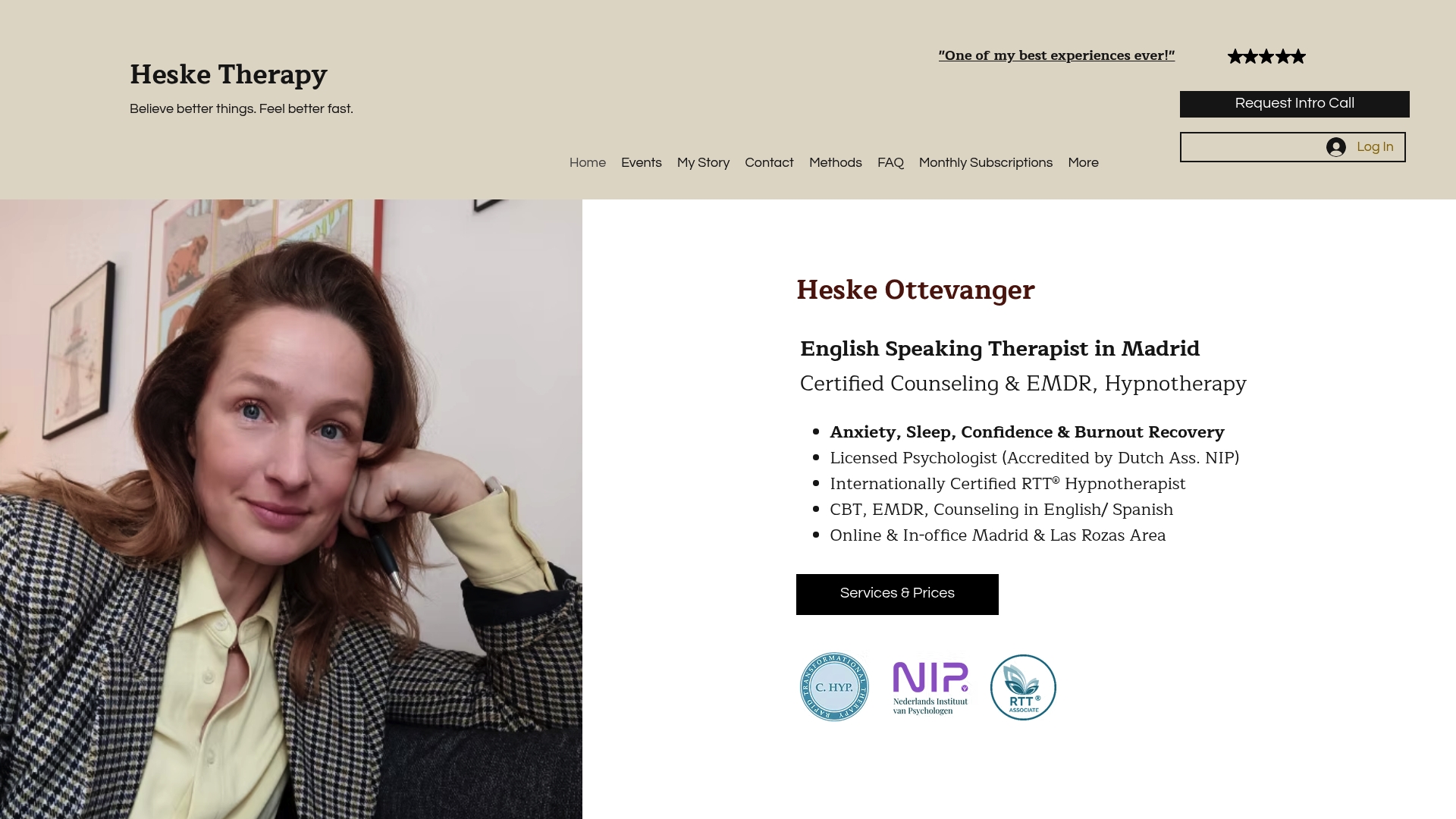
For people who want fast, lasting results without years of open-ended talk therapy, Hesketherapy’s EMDR and hypnotherapy services provide a structured path forward. Online sessions make it accessible regardless of where you are based. A free discovery call is available to help you identify which approach fits your situation before committing to a full program. You can also explore anxiety therapy options to see how different methods compare for your specific concerns.
FAQ
What is the most effective therapy for anxiety?
CBT is the most researched and widely recommended therapy for anxiety disorders, including generalized anxiety, social anxiety, and panic disorder. EMDR is also effective when anxiety is rooted in specific traumatic experiences.
How do I know which therapy approach is right for me?
The best therapy match depends on your primary challenge: CBT for thought-based anxiety, DBT for emotional dysregulation, EMDR for trauma, and ACT for chronic stress or burnout. A qualified therapist can assess your needs in an initial consultation.
How many sessions does EMDR take?
EMDR sessions run roughly 90 minutes, and single-trauma cases often show significant improvement after approximately three sessions. Complex or repeated trauma typically requires more.
What is the difference between CBT and DBT?
CBT targets distorted thinking patterns and is used broadly for anxiety and depression. DBT is a specialized form of CBT that adds acceptance strategies and group skills training, designed specifically for intense emotional dysregulation.
Can a therapist use more than one approach?
Yes. Integrative therapy blends multiple modalities such as CBT, ACT, and somatic techniques within a single treatment plan, tailored to the individual client’s needs and progress.
Recommended
Comments