Multicultural Counseling Guide for Better Client Outcomes


TL;DR:
Cultural misunderstandings in therapy damage trust, misguide diagnoses, and hinder effective support for clients. Building genuine cross-cultural competence requires ongoing humility, self-awareness, and adapting techniques to each client’s unique background. Success is measurable through client engagement, trust, symptom progress, and direct feedback on cultural sensitivity.
When cultural misunderstandings slip into a therapy session, they don’t just create awkward moments. They fracture trust, distort diagnoses, and push clients away from the very help they need. This multicultural counseling guide exists to fix that. Whether you’re a practicing therapist, a counselor in training, or someone supporting mental health work in diverse communities, you’ll find concrete strategies here for building real cross-cultural competence. Not the checkbox kind. The kind that actually changes outcomes for clients whose experiences fall outside the dominant cultural frame.
Table of Contents
Key takeaways
Point | Details |
All counseling is multicultural | Every counselor-client pair brings different cultural lenses, making cultural awareness non-negotiable. |
Cultural humility beats mastery | Ongoing self-reflection and openness to correction matter more than claiming expertise. |
Adapt your tools to the client | Standard assessments may misread culturally normal behavior as pathology in minority populations. |
Feedback drives improvement | Client perception of your multicultural competence directly shapes their engagement and outcomes. |
Training must be continuous | Annual cultural competence training is a compliance requirement and a professional necessity. |
The foundations of multicultural counseling
Before you apply any technique, you need to understand what you’re actually working with. All counseling is inherently multicultural because every counselor and every client sees the world through a distinct cultural lens. That lens shapes what a client calls a problem, how they describe suffering, and whether they trust you enough to speak honestly.
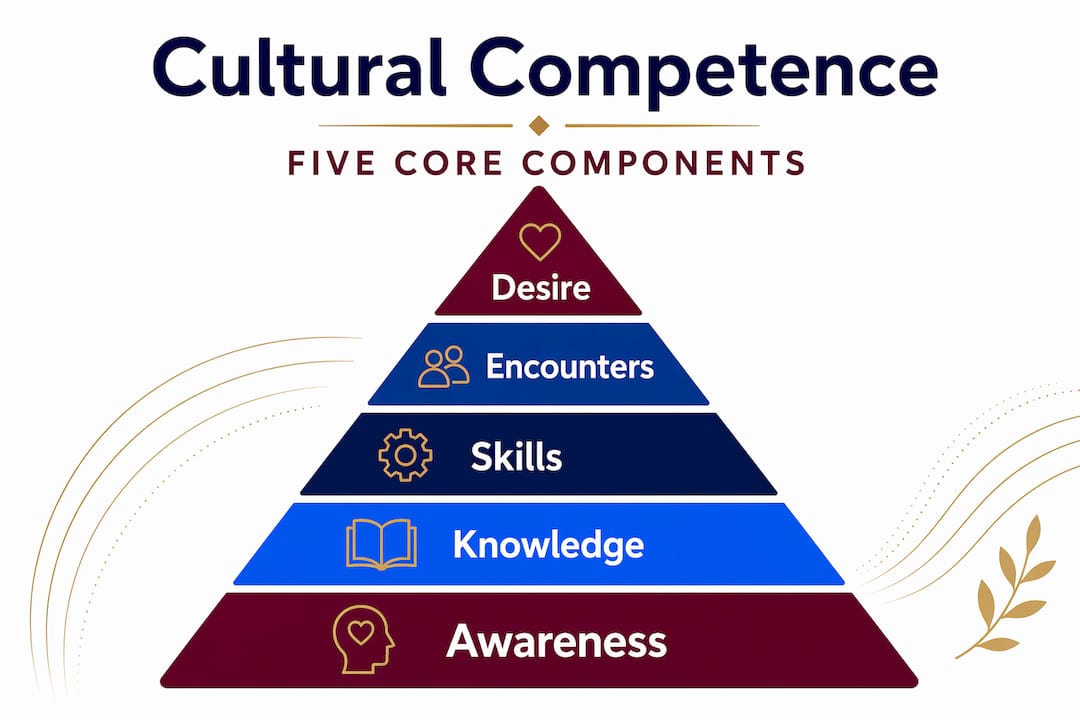
Cultural competence in counseling has five recognized components: awareness of your own cultural background, knowledge of other cultures, practical skill in cross-cultural interaction, actual encounters with diverse populations, and the genuine desire to serve them well. Most training programs cover the first three and skip the last two. That gap shows in practice.
Beyond competence, there’s cultural humility. The distinction matters. Cultural humility requires therapists to approach each client as a learner and stay open to being corrected. You are not the expert on your client’s culture. They are. Competence training gives you a framework. Humility keeps you from misusing it.
Here are the prerequisites you should address before working with diverse client populations:
Self-examination of bias: Write a positionality statement. Identify how your own race, class, religion, gender, and professional background shape what you consider “normal” behavior or “appropriate” distress.
Ongoing cultural competence training: Many healthcare organizations require annual training by December 31st for compliance. Treat this as a floor, not a ceiling.
Recognition of invisible identities: Culture includes socioeconomic class and professional subcultures, not just race or nationality. A first-generation college student and a legacy professional may share an ethnicity but carry vastly different cultural scripts into therapy.
Language competence planning: Know your limits. If you cannot conduct a session in a client’s preferred language, build a plan for qualified interpreter support.
Pro Tip: Before your next session with a new client from a different background, spend five minutes writing down your assumptions about how they might present. Then set those assumptions aside. The act of naming them reduces the chance they’ll run on autopilot during the session.
How to apply counseling techniques for diversity
Good intentions don’t translate into good technique automatically. Here is a step-by-step approach to integrating cultural understanding into your actual practice.
Build rapport through culturally attuned communication. Before diving into assessment, invest time in understanding how your client relates to authority figures, to disclosure, and to the concept of mental health itself. In many cultures, discussing emotional distress with a stranger is deeply stigmatized. Acknowledging this openly, without pathologizing it, builds more trust in ten minutes than months of standard rapport-building.
Adapt your listening style. Active listening and empathetic questioning close communication gaps, but you have to adjust for nonverbal cues and the meaning of silence. In some cultures, silence during a session signals respect or deep reflection. In others, it signals discomfort or dissociation. Misreading it is costly.
Reassess your assessment tools. Standard psychological assessments may misinterpret culturally normative behaviors as pathology in minority populations, largely because many tests were developed on predominantly white samples. Where possible, use culturally validated instruments or supplement standard tools with qualitative inquiry.
Incorporate the client’s cultural identity into treatment. Ask directly about cultural or spiritual practices that support their well-being. If a client finds grounding through prayer, ancestral rituals, or community ceremonies, those are not obstacles to therapy. They are resources. Engaging clients through cultural stories and family inclusion strengthens the therapeutic relationship and improves adherence.
Address cross-cultural power dynamics with transparency. If you belong to a dominant cultural group and your client does not, name the dynamic at some point. Not as a confession, but as an acknowledgment that it exists and that you are aware of it. Clients who have experienced historical or institutional trauma are often watching for signs of it in the therapy room. Naming the dynamic is one of the most disarming moves available to you.
Pro Tip: If your client seems disengaged or gives short answers, consider whether the format of therapy itself is culturally misaligned. Some clients respond far better to a walk-and-talk format, to session structures that include family members, or to problem-focused approaches over exploratory ones. Flexibility in format is part of inclusive therapy approaches.
Common challenges in multicultural practice
Even skilled practitioners hit walls. Knowing which walls to expect reduces the damage when you do.
Language barriers: These go beyond vocabulary. Fluency gaps change how clients describe severity, emotion, and context. A client who rates their depression as “medium” in a second language may have no word in that language for the crushing weight they actually feel. Multilingual support, when available, significantly changes the picture. Research on multilingual therapy for expats confirms this repeatedly.
The stereotyping versus cultural blindness trap: Counselors often swing between two errors. The first is applying cultural generalizations too rigidly, treating a Mexican client as a monolith of “Latino culture” instead of an individual. The second is ignoring cultural context entirely in the name of treating everyone the same. Ongoing self-reflection and supervision are the only reliable correctives.
Historical trauma and institutional mistrust: Many clients from marginalized communities arrive with entirely rational reasons to distrust mental health systems. Those systems have a documented history of pathologizing difference, overdiagnosing certain populations, and underserving others. Acknowledge this history without defensiveness. It is relevant.
Ethical tensions between autonomy and cultural norms: A client’s cultural community may hold values that conflict with dominant therapeutic frameworks around individualism, self-disclosure, or help-seeking. Forcing a Western model of self-actualization onto a client who values collective identity over individual agency is not neutral. It’s a form of cultural imposition. Ethical cross-cultural therapy means holding the tension between the client’s community context and their individual welfare without defaulting to either extreme.
Resource limitations: Mental health provider shortages hit culturally diverse and linguistically isolated communities hardest. When in-person specialized support isn’t accessible, online options become critical. For expat and international communities, online therapy for expats fills a gap that traditional clinic-based models simply cannot.
Measuring success in multicultural counseling
How do you know it’s working? The answer is more specific than “the client seems better.”

Indicator | What to look for |
Client engagement | Attendance consistency, session participation, willingness to discuss sensitive topics |
Therapeutic alliance quality | Client-reported trust, comfort raising disagreements, openness about cultural context |
Symptom progress | Changes in standardized measures, adapted for cultural validity |
Client feedback on cultural sensitivity | Direct ratings or open-ended responses about whether they feel understood |
Practitioner self-assessment | Regular supervision notes reflecting on cultural dynamics in sessions |
Clients’ perception of counselor multicultural competence directly correlates with satisfaction and therapeutic alliance quality. That makes client feedback one of your most accurate performance indicators, not just a courtesy measure.
Educational interventions in clinical training settings show that cultural competence gains require continued real-world clinical experience to hold. Reading about cross-cultural therapy isn’t enough. You need regular supervision with practitioners who will push back on your blind spots, and you need to actively seek out feedback from clients whose backgrounds differ significantly from your own.
Cultural competency efforts aligned with organizational goals produce stronger, more sustained results than training treated as a compliance checkbox. If you’re building a practice or working within an institution, integrate multicultural competence into your clinical standards, not your HR calendar.
My take on what multicultural counseling actually requires
I’ll say the quiet part out loud. Most cultural competence training is too comfortable. It teaches counselors about other cultures, which creates a false confidence that’s sometimes more dangerous than knowing nothing.
What I’ve found in practice is that the real work starts after the training ends. The sessions that taught me the most were the ones where a client gently told me I had gotten something wrong. Not just about their culture, but about them. And they were right. That moment of correction, if you receive it well, is where the actual therapeutic relationship begins.
The counselors who do this work best aren’t the ones who’ve read the most research on cultural identity models. They’re the ones who stay genuinely curious about each individual in front of them, who treat their own cultural framework as one possible frame rather than the default. That’s harder than it sounds when your training has given you a comprehensive model that feels satisfying to apply.
Working with expats and internationally mobile clients has shown me how much invisible culture shapes distress. The executive who moved from Seoul to Madrid brings not just Korean cultural norms but a specific professional subculture, a relationship to success and failure, and a set of expectations about privacy that no cultural profile captures. You have to ask. And then you have to listen in a way that doesn’t immediately sort what you hear into your existing categories.
Multicultural counseling is not a destination. It’s an ongoing process with no endpoint. The counselors who treat it that way produce better outcomes. Full stop.
— Heske
Work with a therapist who gets your cultural context
If you’re looking for therapy that actually accounts for who you are and where you come from, cultural fit matters as much as clinical skill.
At Hesketherapy, sessions are conducted in English, Spanish, and Dutch, with specific experience supporting international clients, expats, and people navigating identity across cultures. Whether you’re dealing with anxiety, burnout, or the particular weight of living far from home, the approach here is built around your context, not a generic template. Explore the in-office counseling sessions available in Madrid, or learn how RTT therapy delivers faster results for clients who need real change without a year-long waiting list.
FAQ
What is multicultural counseling?
Multicultural counseling is a therapeutic approach that accounts for the cultural backgrounds, identities, and experiences of both the client and the counselor. All counseling is inherently multicultural because culture shapes how both parties interpret communication, distress, and healing.
How does cultural competence differ from cultural humility?
Cultural competence refers to knowledge and skills in working across cultures. Cultural humility goes further: it means treating each client as the authority on their own experience and staying genuinely open to correction, rather than applying cultural frameworks as fixed rules.
Why do standard assessments sometimes fail with diverse clients?
Many widely used psychological tests were developed on predominantly white populations and lack validation across cultural groups. This means they can misinterpret culturally normal behavior as pathology, leading to misdiagnosis and inappropriate treatment.
How often should counselors complete cultural competence training?
Annual training by December 31st is required by many healthcare organizations for compliance purposes. Beyond compliance, ongoing supervision and real-world diverse client experience are what actually build lasting competence.
How do you measure effectiveness in multicultural counseling?
Track client engagement, therapeutic alliance quality, symptom change on culturally validated measures, and direct client feedback on whether they feel culturally understood. Client perception of your multicultural competence is one of the strongest predictors of positive outcomes.
Recommended
Comments