Essential CBT techniques for anxiety & trauma relief


TL;DR:
CBT offers targeted, practical techniques for managing anxiety, trauma, and burnout in expats.
Techniques like cognitive restructuring and exposure therapy are highly effective for specific mental health issues.
Personalized CBT approaches work well for expats, especially when adapted to cultural and individual needs.
Finding reliable mental health support as an English-speaking expat in Madrid can feel overwhelming. You’re navigating a new culture, a different language, and real emotional pressure, all at once. Anxiety, burnout, and trauma don’t pause while you settle in. Cognitive Behavioral Therapy, or CBT, is one of the most researched and effective approaches for exactly these challenges. But with so many techniques out there, knowing where to start matters. This guide gives you a practical, expert-backed list of core CBT techniques, explains how they work, and helps you figure out which ones fit your situation best.
Table of Contents
Key Takeaways
Point | Details |
CBT matches expat needs | CBT techniques directly address anxiety, trauma, and burnout typical for expatriates living abroad. |
Six core techniques | Cognitive restructuring, exposure therapy, behavioral activation, problem-solving, relaxation, and mindfulness provide versatile relief options. |
Empirical effectiveness | CBT is proven to show large effect sizes for anxiety and trauma yet remains flexible for tailored, real-world use. |
Practical implementation | Success relies on adapting CBT techniques to daily life and working collaboratively with therapists. |
Accessible support | Services like Heske Therapy can help expats choose and apply CBT or complementary therapies for optimal mental health. |
How to select the right CBT technique for your needs
Not every CBT technique suits every problem. Before you pick a method, it helps to understand what CBT actually targets and why that matters for your specific situation.
CBT works differently from many other therapy styles. Rather than spending months unpacking your childhood, it zeroes in on what’s happening right now. CBT prioritizes short-term, problem-oriented interventions focused on current thoughts and behaviors. That’s a significant advantage if you’re dealing with acute anxiety, expat-related burnout, or recent trauma and need results without years of open-ended sessions.
To choose the right technique, start by identifying your primary challenge. Ask yourself these questions:
Anxiety: Are you experiencing excessive worry, panic attacks, or social anxiety in new environments?
Burnout: Are you emotionally exhausted, detached, or feeling like nothing is working no matter how hard you try?
Trauma: Have you experienced a distressing event that keeps replaying in your thoughts or affecting your daily functioning?
Emotional distress: Are you struggling with low self-esteem, persistent sadness, or difficulty managing strong emotions?
Once you identify your primary concern, you can match it to the most relevant technique. Understanding what is CBT in a broader sense also helps you see how these tools fit together as a system rather than isolated tricks.
There’s also a practical versus theoretical divide worth knowing. Some techniques, like behavioral activation, are highly action-oriented. You do something first, and the shift in thinking follows. Others, like cognitive restructuring, start with your thoughts. Neither is universally superior. Your therapist will help you decide based on where you’re most stuck.
Pro Tip: If you’re new to CBT, start with one technique and practice it consistently for two weeks before adding another. Overloading yourself with methods is a common mistake that slows progress.
For a more structured starting point, the step-by-step CBT for anxiety guide walks through practical applications you can begin using right away.
The definitive list of core CBT techniques
Once you have your criteria, here’s a breakdown of the main CBT methods to match your needs.
Core CBT techniques include cognitive restructuring, exposure therapy, behavioral activation, problem-solving, relaxation training, and mindfulness integration. Each one targets a different layer of how anxiety, trauma, or burnout affects you.
“The power of CBT lies not in any single technique, but in how these tools work together to interrupt the cycle between thoughts, feelings, and behaviors.”
Here’s what each technique involves:
Cognitive restructuring: You identify distorted or unhelpful thoughts, challenge them with evidence, and replace them with more balanced ones. Especially useful for expats who catastrophize social situations or over-interpret cultural misunderstandings.
Exposure therapy: You gradually face feared situations or memories in a safe, controlled way. This reduces avoidance and the anxiety that feeds it. Ideal for social anxiety, phobias, or trauma responses.
Behavioral activation: You schedule and engage in activities that bring a sense of achievement or pleasure, even when motivation is low. A go-to technique for burnout and depression.
Problem-solving: You break down overwhelming challenges into manageable steps with concrete action plans. Particularly practical for expats managing relocation stress, work pressure, or family strain.
Relaxation training: Techniques like progressive muscle relaxation and diaphragmatic breathing reduce the physical symptoms of anxiety and stress.
Mindfulness integration: You learn to observe thoughts and feelings without reacting to them automatically. Mindfulness in CBT helps you create space between a trigger and your response.
Technique | Primary target | Format |
Cognitive restructuring | Anxiety, low self-esteem | Thought records, journaling |
Exposure therapy | Phobias, PTSD, social anxiety | Gradual hierarchy exercises |
Behavioral activation | Burnout, depression | Activity scheduling |
Problem-solving | Stress, overwhelm | Structured planning sessions |
Relaxation training | Physical tension, panic | Breathing and body exercises |
Mindfulness integration | Emotional reactivity | Daily awareness practices |
For a deeper look at how these apply specifically to expat life, the effective CBT techniques resource offers context tailored to your situation.
Comparing CBT technique effectiveness for anxiety, trauma, burnout
With technique definitions covered, this section clarifies which tools work best for specific challenges and provides comparison data for informed choices.
Not all techniques perform equally across different conditions. Research shows that CBT produces large effect sizes for anxiety and trauma, with outcomes in routine clinical settings comparable to those seen in controlled efficacy trials. That’s reassuring. It means what works in research also works in real therapy rooms.
Here’s how the evidence breaks down by challenge:
Anxiety: Cognitive restructuring and exposure therapy lead the pack. Cognitive restructuring targets distortions like catastrophizing and mind-reading. Exposure therapy uses systematic desensitization, in-person confrontation of feared situations, and imaginal exposure for memories.
Trauma and PTSD: Trauma-focused CBT, prolonged exposure, and cognitive processing therapy are the gold-standard approaches. These are structured, evidence-backed, and recommended by major clinical bodies.
Burnout: Behavioral activation and problem-solving show the strongest results. They address the withdrawal and helplessness that define burnout without requiring deep emotional excavation first.
Condition | Most effective technique | Effect size |
Anxiety | Cognitive restructuring, exposure therapy | Large |
Trauma/PTSD | Trauma-focused CBT, prolonged exposure | Large |
Burnout | Behavioral activation, problem-solving | Moderate to large |
Emotional distress | Mindfulness integration, relaxation training | Moderate |
One finding that surprises many people: there is no proven superiority of manualized CBT (following a fixed protocol) over individualized CBT tailored to your specific needs. This matters because it validates the kind of personalized approach that works best for expats, whose stressors rarely fit a textbook mold.
If you’re weighing your options, the CBT for anxiety resource offers expat-specific context. And if you’re curious how CBT compares to other modalities, CBT vs RTT for trauma breaks down the key differences clearly.
Real-world CBT implementation: Tailoring techniques for expats
Comparison aside, you’ll want to know how to actually put these techniques to work. Here’s what implementation looks like for expats in Madrid.

The most effective CBT doesn’t happen in isolation. Mechanics emphasize collaborative empiricism, Socratic questioning, and the principle that behavioral change often precedes cognitive shifts. In plain terms: you and your therapist work as a team, testing ideas together rather than the therapist simply telling you what to think.
For expats, a few implementation principles make a real difference:
Adapt the content, not the method: The techniques themselves are universal. What changes is the material you apply them to. Your thought records might focus on cultural isolation or workplace dynamics in Spain rather than generic worry.
Use Socratic questioning on yourself: When you notice a negative thought, ask: “What’s the evidence for this? What would I tell a friend in this situation?” This self-reflection builds the same muscle that therapy sessions develop.
Start with behavior, not insight: If motivation is low, don’t wait to feel ready. Schedule one small activity, complete it, and notice how your thinking shifts afterward. Doing often unlocks the insight that thinking alone can’t reach.
Avoid perfectionism in practice: CBT homework doesn’t need to be perfect. A partially completed thought record is more useful than a blank one.
Pro Tip: Keep a brief daily log of one situation, your automatic thought, and an alternative perspective. Even five minutes a day builds the habit faster than longer, infrequent sessions.
For expats dealing with layered challenges, integrative therapy tips show how CBT can combine with other approaches. And if trauma is part of your picture, trauma-focused therapy insights offer important guidance on pacing and safety.
Also worth noting: the PTSD treatment guidelines updated in 2025 reinforce that trauma-focused CBT remains the frontline recommendation, even when other symptoms like anxiety or burnout are present alongside trauma.
CBT wisdom for expatriates: What most guides miss
Most CBT guides read like instruction manuals. They list techniques, cite studies, and send you on your way. What they rarely address is the messy, real-world experience of actually using these tools when you’re living far from your support network, working in a second language, and managing an identity that feels split between two cultures.
Working with expats in Madrid, one pattern stands out clearly. The clients who make the fastest progress are not the ones who follow CBT most rigidly. They’re the ones who adapt it. They use cognitive restructuring for cultural friction, not just generic worry. They apply behavioral activation to rebuild social connection, not just fight depression.
Research backs this up. Effectiveness is maintained in routine care just as well as in clinical trials, and individualized CBT performs as well as manualized versions. That’s permission to make CBT yours.
The uncomfortable truth is that textbook CBT was not designed with expat life in mind. But its core principles, testing thoughts, changing behavior, building tolerance, are exactly what expat life demands. The CBT for expats approach and CBT vs RTT solutions both reflect this: the format matters less than the fit.
Explore rapid transformation or ongoing CBT with Heske Therapy
CBT gives you a powerful toolkit. But sometimes, knowing the techniques isn’t enough. Having a skilled therapist who understands expat life in Madrid makes the difference between reading about change and actually experiencing it.
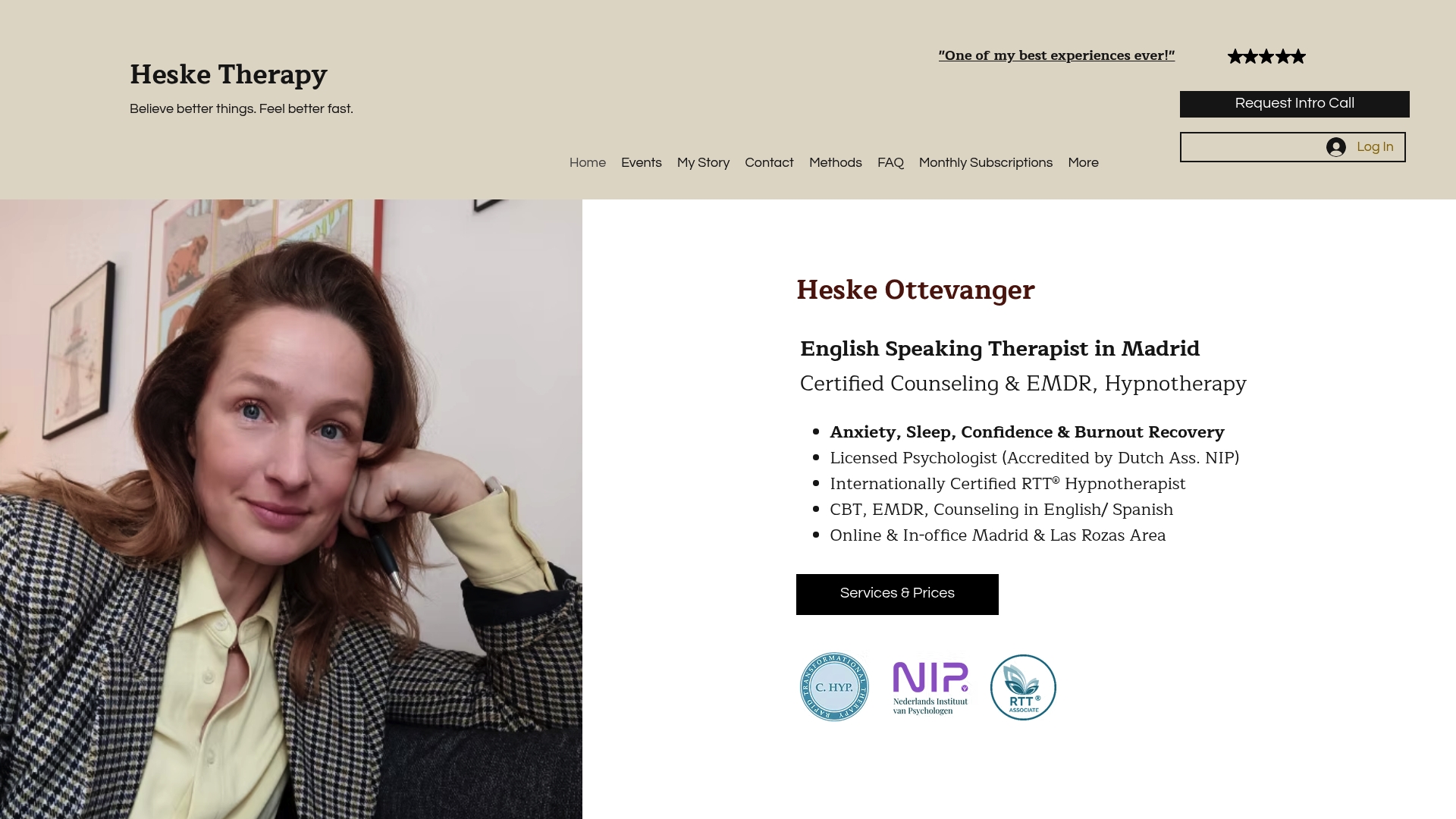
At Heske Therapy, we offer both ongoing CBT support and RTT for rapid transformation, a method that can accelerate the breakthroughs that CBT builds toward. For those ready to go deeper, the 21-day RTT package combines intensive work with lasting follow-through. Sessions are available in English, in-person in Madrid or online. If you’re ready to move from understanding CBT to actually feeling better, reach out for a free discovery call today.
Frequently asked questions
What is the most effective CBT technique for anxiety?
Cognitive restructuring and exposure therapy are the most effective for various forms of anxiety, targeting distorted thinking and avoidance behaviors directly, per APA guidelines.
Are CBT techniques suitable for trauma and PTSD?
Yes. Trauma-focused CBT and cognitive processing therapy are highly recommended for PTSD and are considered frontline treatments by the APA.
Can CBT help with burnout for expats?
Absolutely. Behavioral activation and problem-solving are especially effective for burnout, helping you re-engage with meaningful activities and break the cycle of exhaustion and withdrawal.
Are CBT outcomes as reliable in routine care as in clinical trials?
Yes. CBT effectiveness in routine care matches clinical trial outcomes, and tailored individual approaches perform just as well as fixed manualized protocols.
Recommended
Comments