RTT vs CBT Therapy: Rapid Relief for Expats

Feeling stretched thin in Madrid as an English-speaking expat, you may find anxiety and burnout are harder to shake off so far from home. Choosing between talk therapy and rapid relief can feel confusing when every day brings new pressures. Understanding the core difference between Rapid Transformational Therapy (RTT) and Cognitive Behavioral Therapy (CBT) gives you the clarity to select the approach that best fits your pace, needs, and path toward feeling better fast.
Table of Contents
Key Takeaways
Point | Details |
Understand Therapy Approaches | Rapid Transformational Therapy (RTT) offers quick results in 1-3 sessions, while Cognitive Behavioral Therapy (CBT) is structured over 8-20 sessions for gradual change. |
Choose Based on Needs | Opt for CBT if you prefer skill-building and have time, or RTT if you seek immediate relief from anxiety or burnout. |
Consider Hybrid Methods | Many expats benefit from a combined approach—using RTT for rapid breakthroughs followed by CBT for reinforcing daily coping strategies. |
Communicate with Your Therapist | Be clear about your specific needs and circumstances during initial consultations to align the therapeutic approach with your goals. |
Defining RTT and CBT: Core Principles
As an expat in Madrid managing anxiety or burnout, understanding the difference between these two therapy approaches can help you choose the right path forward. Both Rapid Transformational Therapy (RTT) and Cognitive Behavioral Therapy (CBT) offer proven results, but they work in fundamentally different ways.
How CBT Works
CBT operates on a straightforward principle: your thoughts, feelings, and behaviors are interconnected. By changing how you think about situations, you can shift how you feel and act.
The approach involves:
Identifying unhelpful thought patterns (like catastrophizing about job security in a new country)
Challenging those thoughts with evidence
Replacing them with more balanced perspectives
Practicing new behaviors that reinforce positive changes
CBT typically requires multiple sessions spread over weeks or months. You work actively between sessions, practicing techniques and tracking progress. This structured, gradual approach has decades of research supporting its effectiveness for anxiety, depression, and stress.
CBT works best when you’re willing to do the cognitive work—examining and questioning your thoughts systematically.
How RTT Works
Rapid Transformational Therapy combines hypnotherapy, CBT, and neuro-linguistic programming to create rapid shifts in 1-3 sessions rather than months of therapy. Instead of analyzing thoughts step-by-step, RTT uses guided trance states to access your subconscious directly.
Here’s the difference:
RTT identifies the root belief or memory creating your anxiety—often something from childhood or a past experience
While in a relaxed trance state, your mind becomes more open to reframing that belief
Your brain essentially rewires its response, using neuroplasticity to create lasting change fast
You leave each session with concrete mental tools and a personalized recording to reinforce the shift
Many expats find RTT appealing because it works quickly. If you’ve been struggling with burnout and need relief within weeks, not months, this matters significantly.

Key Differences at a Glance
Aspect | CBT | RTT |
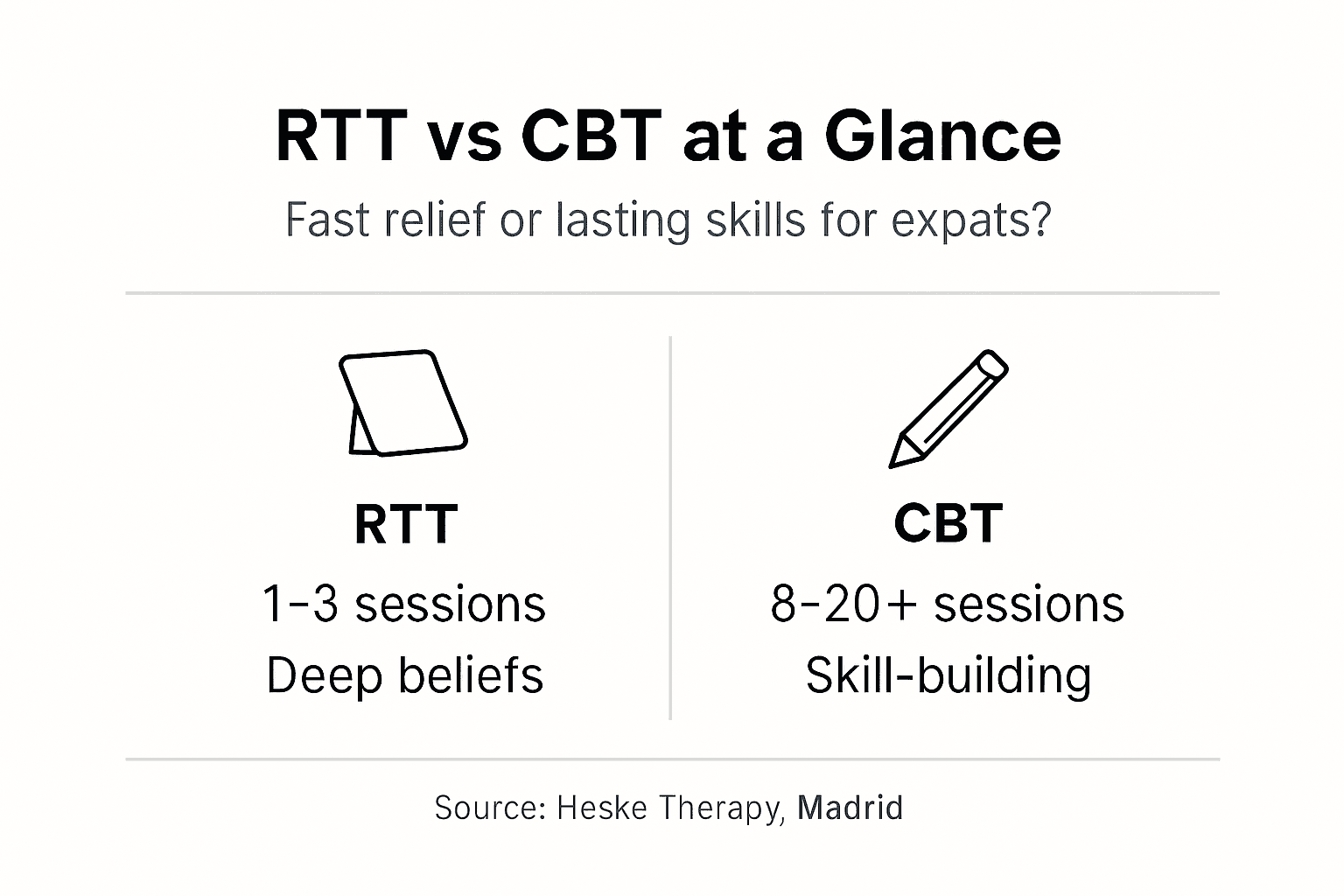
Timeline | 8-20+ sessions | 1-3 sessions |
Method | Analyzing and challenging thoughts | Accessing subconscious beliefs via trance |
Session structure | Conversation-based | Hypnotherapy-based |
How change happens | Gradual cognitive shifts | Fast reframing of root beliefs |
Homework | Extensive between-session work | Listen to personalized recording |
Which Is Right for You?
Choose CBT if you prefer understanding the mechanics of your thinking, don’t mind a longer timeline, and want to actively participate in gradual change.
Choose RTT if you want fast results, struggle with ruminating thoughts, or feel stuck despite years of self-analysis.
Pro tip: Many expats benefit from combining both approaches—using RTT for rapid breakthrough on core beliefs, then CBT techniques to reinforce daily habits during your adjustment to Madrid life.
How RTT and CBT Work in Practice
Understanding how these therapies actually function in real sessions helps you decide which fits your life as an expat in Madrid. Both work differently, and that difference shapes your entire treatment experience.
A CBT Session: What Happens
CBT is a structured, goal-oriented therapy where you work collaboratively with your therapist to identify and change unhelpful thought patterns. Each session follows a clear structure.
Here’s what you’ll typically do:
Discuss current challenges and how your thoughts affect your mood
Learn specific techniques like cognitive restructuring (examining evidence for and against your anxious thoughts)
Practice behavioral activation (taking small actions even when anxiety is high)
Receive homework assignments to practice between sessions
Track progress week to week
You meet weekly, usually for 8 to 20 sessions or more. The work is gradual and builds momentum over time. By the end, you’ve developed lasting skills to manage anxiety yourself.
CBT works because you’re actively rewiring your thinking patterns through repetition and practice over weeks.
An RTT Session: What Happens
RTT therapy operates by inducing a trance-like state through hypnotherapy, allowing your therapist to access your subconscious directly. This is where the speed comes from.
A typical RTT session looks like this:
You discuss what brought you in (burnout, anxiety, sleep issues)
Your therapist guides you into a relaxed, focused trance state
While in trance, regression techniques help uncover the root belief creating your problem
Your therapist reframes that belief using hypnotic conditioning and NLP
You leave with a personalized recording to listen to daily for 21 days
Most clients complete treatment in 1 to 3 sessions total
The speed feels almost shocking compared to traditional therapy. Many expats report feeling noticeably different after their first session.
Real-World Comparison for Expats
Your Situation | CBT Approach | RTT Approach |
Starting a new job in Madrid anxiety | Work through worry thoughts over 8 weeks | Uncover childhood belief about performance in 1 session |
Insomnia from relocation stress | Practice sleep hygiene, thought records, relaxation for 6+ weeks | Identify and reframe the anxiety trigger in trance, listen to recording nightly |
Relationship tension due to burnout | Build communication skills and assertiveness gradually | Access root pattern and reprogram response in 1-2 sessions |
Speed vs. Depth
CBT requires patience but builds sustainable habits you control. RTT bypasses the analysis and goes straight to the source, but you need to trust the process happening beneath conscious awareness.
Your preference matters here. If you’re skeptical of hypnosis or prefer understanding the “why” behind your healing, CBT feels safer. If you’re exhausted and need relief fast, RTT’s speed becomes invaluable.
Pro tip: Ask your therapist about a hybrid approach—RTT for the breakthrough, then a few CBT sessions to cement the new thinking patterns into daily life.
Key Differences: Speed, Depth, and Focus
The choice between RTT and CBT often comes down to three factors: how fast you need results, how deeply you want to explore your issues, and what aspect of yourself you’re targeting. These differences shape your entire therapy journey.
Speed: The Most Obvious Difference
RTT aims to deliver rapid results often within a single session through deep subconscious engagement. CBT, by contrast, is structured over weeks or months of consistent work.
This matters practically:
RTT: 1 to 3 sessions total, with changes felt immediately
CBT: 8 to 20+ sessions, with gradual improvement over time
RTT: Ideal when you’re burned out and need relief now
CBT: Better when you have time to invest in skill-building
For expats managing relocation stress alongside work demands, the speed difference feels significant. You might not have months to dedicate to weekly therapy sessions.
RTT’s speed comes from accessing your subconscious directly, while CBT builds change through conscious practice and repetition.
Depth: Where You’re Working
RTT focuses on uncovering and transforming root causes buried in the subconscious, while CBT emphasizes conscious cognitive and behavioral changes. This distinction matters for what you’ll actually experience.
RTT dives deep into:
Childhood beliefs and early experiences
Unconscious patterns running your anxiety or avoidance
The “why” beneath the surface problem
Neuroplasticity to rewire your brain’s automatic responses
CBT works on:
Present thoughts and behaviors you can observe
Practical skills to manage anxiety day-to-day
Changing how you respond to situations
Building habits through conscious effort
If you’ve tried self-help and therapy before without lasting relief, you might need RTT’s deeper intervention. If you’re new to therapy, CBT’s structured approach feels more manageable.
Focus: Subconscious vs. Conscious
CBT is collaborative problem-solving—you and your therapist work together on thoughts you can identify and challenge. You’re actively involved in every step.
RTT involves hypnotic conditioning and regression. You’re guided inward, working with your subconscious while your conscious mind relaxes. You trust the process rather than directing it.
This distinction matters for personality fit. Some people find CBT’s partnership reassuring. Others find RTT’s trust-based approach liberating.
The Timeline Reality
Metric | CBT | RTT |
Sessions needed | 8-20+ | 1-3 |
Timeline | 2-6 months | 2-4 weeks |
Conscious effort | High (homework daily) | Moderate (listen to recording) |
Subconscious work | Minimal | Central |
Skill-building | Extensive | Minimal |
Which Matches Your Situation?
Choose speed and depth if you need breakthrough results fast and believe the root issue runs deeper than your conscious thoughts.
Choose structure and skill-building if you want to understand your healing process and develop lasting coping tools.
Pro tip: Ask your therapist about a sequential approach—RTT first for rapid breakthrough, then 3 to 4 CBT sessions to anchor the changes into daily habits and thought patterns.
Who Benefits Most: Suitability for Expat Needs
Not every therapy works equally well for every person. Your situation as an expat in Madrid shapes which approach serves you better. Understanding your specific needs matters more than choosing based on hype.
RTT Works Best When You Have Limited Time
If you’re juggling a demanding job, relocation logistics, and cultural adjustment simultaneously, RTT’s speed becomes invaluable. RTT’s rapid and solution-focused methodology can be particularly effective for time-constrained expatriates seeking quick relief from anxiety or burnout rooted in past trauma.
You’re ideal for RTT if:
You need results within 2 to 4 weeks, not months
You’re exhausted and don’t have energy for weekly homework
You suspect your anxiety stems from a specific past experience or belief
You’re skeptical of lengthy processes and prefer direct intervention
You’ve tried therapy before without lasting relief
Many expats face acute stress during their first year abroad. RTT targets these acute challenges efficiently, addressing the subconscious roots quickly.
Below is a summary of typical client profiles and which therapy approach tends to suit their needs best:
Client Profile | Best Fit | Why This Approach |
Busy expat with acute stress | RTT | Offers rapid relief in weeks |
Expat facing ongoing adjustment challenges | CBT | Builds lasting coping skills |
Someone skeptical of hypnosis | CBT | Structured steps and transparency |
Person with unresolved past trauma | RTT | Direct subconscious intervention |
Expat wanting measurable progress | CBT | Provides clear skill-building outcomes |
Seeking fast change for sudden burnout | RTT | Minimizes time and homework needed |
RTT delivers transformative changes in confidence, anxiety, and emotional resilience for those facing transient or acute challenges in cross-cultural settings.
CBT Works Best When You Want to Build Long-Term Skills
CBT is widely recommended for managing common psychological issues such as anxiety and depression among diverse populations, including expatriates, due to its evidence-based structured approach that builds coping skills adaptable to new cultural and social contexts.
You’re ideal for CBT if:
You want to understand the “why” behind your anxiety
You have time to invest in weekly sessions over 8 to 12 weeks
You prefer active participation in your healing process
You’re building a new life in Madrid and need sustainable coping tools
You enjoy structure and measurable progress
You’re new to therapy and want something evidence-based and straightforward
CBT’s gradual and collaborative nature helps you navigate stressors related to cultural adjustment and isolation—common expat struggles that unfold over time.
The Expat-Specific Decision Framework
Ask yourself these questions:
Urgency: Do you need relief in weeks or can you wait for months?
Exploration: Do you want to understand your patterns, or just eliminate the anxiety?
Energy: Do you have bandwidth for weekly therapy plus daily homework?
History: Is this acute stress (new to you) or chronic patterns you’ve carried for years?
Support system: Are you building a life in Madrid long-term, or might you relocate again soon?
If you answered “weeks,” “eliminate,” “limited,” “chronic,” and “might relocate,” RTT fits better. If you answered the opposite, CBT is your answer.
Your Language and Culture Matter
Choosing an English-speaking therapist as an expat matters regardless of which approach you select. Both RTT and CBT require trust and clear communication. Speaking your native language removes an unnecessary barrier.
Pro tip: Book a free discovery call and describe your specific situation honestly—burnout timeline, past therapy experiences, and what relief means to you. Your therapist can recommend RTT, CBT, or a hybrid approach based on your actual needs, not generic guidelines.
Choosing the Right Approach for Lasting Relief
Picking between RTT and CBT isn’t about finding the “best” therapy—it’s about finding the best fit for your life right now. Lasting relief comes from matching your choice to your actual situation, not theoretical ideals.
The Core Decision: Speed or Skill-Building?
Choosing between CBT and RTT depends on client needs: CBT is well-suited for those preferring structured, evidence-based treatment with measurable progress, while RTT may suit individuals seeking rapid, deep subconscious change, especially when traditional methods have been less effective.
This fundamental distinction shapes everything:
Choose CBT if you want control and visibility in your healing process
Choose RTT if you want rapid transformation and trust the subconscious process
Choose CBT if you’re building long-term resilience for life in Madrid
Choose RTT if you’re in acute crisis and need relief within weeks
Neither choice is wrong. Your circumstances determine which serves you better right now.
Lasting relief requires matching your therapy choice to your readiness for change, the nature of your issues, and your desired pace of healing.
Consider Your Starting Point
Where you’re starting from matters significantly. If you’ve never done therapy before, CBT’s structured approach feels less intimidating. The step-by-step skill-building provides clear markers of progress.
If you’ve tried therapy multiple times without breakthrough, RTT offers something different. RTT emphasizes empowering clients by uncovering and transforming core limiting beliefs in one to three sessions using neuroplasticity principles to rewire subconscious patterns.
Same with past experiences:
Acute stress from relocation? RTT works faster
Chronic anxiety you’ve managed for years? CBT builds sustainable tools
Specific traumatic event? RTT’s regression can target it directly
Ongoing adjustment challenges? CBT develops adaptable coping skills
The Hybrid Advantage
You don’t have to choose only one. Combining therapy methods can accelerate recovery when done strategically. Many expats benefit most from RTT first—rapid relief from the acute panic or burnout—followed by CBT to build sustainable habits.
This sequence works because:
Here’s a concise breakdown of hybrid therapy benefits for expats:
Benefit | RTT Contribution | CBT Contribution |
Fast symptom relief | Immediate subconscious change | Initial momentum for skill practice |
Sustainable habits | Reframes root beliefs quickly | Anchors new patterns long-term |
Adaptability for relocation | Rapid adjustment support | Tools for future stressors |
Overall resilience | Boosts confidence and calm | Builds self-management skills |
Complements therapy history | Works after failed previous therapies | Develops new strategies post-breakthrough |
RTT removes the urgency and panic quickly
With breathing room, you can engage fully in CBT’s skill-building
CBT anchors the RTT shifts into daily life and new patterns
You get speed and depth without either approach compromising the other
Questions to Ask Before Deciding
Before booking, clarify your priorities:
How urgently do you need relief—weeks or can you wait months?
Have you done therapy before? How did you respond?
Do you trust hypnosis, or does it create skepticism?
Are you willing to do daily homework, or do you prefer minimal effort?
Is this a specific crisis, or a long-standing pattern?
Your answers point toward your answer. If your answers lean toward urgency, trauma, and skepticism of long processes, RTT fits. If they lean toward understanding, patience, and structure, CBT fits.
Pro tip: During a discovery call, be completely honest about what hasn’t worked before and what your life actually allows time-wise—not what you think you “should” do. Your therapist can then recommend the approach with the highest likelihood of lasting relief for your specific situation.
Find Your Fast and Lasting Relief with Heske Therapy in Madrid
Managing anxiety and burnout as an expat can feel overwhelming when you are balancing a new life in Madrid. This article explains the key differences between Rapid Transformational Therapy (RTT) and Cognitive Behavioral Therapy (CBT), highlighting challenges like limited time, emotional exhaustion, and the need for rapid yet deep healing. If you are seeking a solution that fits your unique expat situation and want to break free from persistent stress or self-doubt, Heske Therapy offers tailored treatment plans combining both RTT and CBT techniques to meet your goals effectively.
Discover the benefits of:
Rapid subconscious reframing with RTT for quick breakthrough
Structured skill-building with CBT for sustainable coping
Personalized care in English and multiple languages
Take control of your mental health journey today. Visit Heske Therapy to schedule your free discovery call. Let us help you choose the best approach—RTT, CBT, or a hybrid method—to achieve lasting relief during your expatriate experience in Madrid.
Frequently Asked Questions
What is the main difference between RTT and CBT therapy?
RTT (Rapid Transformational Therapy) focuses on quick changes by accessing the subconscious to reframe root beliefs, often requiring only 1-3 sessions. In contrast, CBT (Cognitive Behavioral Therapy) involves analyzing thought patterns and behaviors over a more extended period, typically spanning 8-20 sessions.
How quickly can I expect results from RTT compared to CBT?
RTT typically delivers results within 1-3 sessions, with immediate changes often noticeable after the first appointment. CBT, however, usually requires several weeks to months of consistent sessions to see substantial results, as it builds skills over time.
Is one therapy more effective for expats dealing with anxiety than the other?
The effectiveness can vary depending on individual needs. RTT may be more suited for expats seeking rapid relief from acute anxiety, while CBT is beneficial for those looking to build long-term coping skills and a deeper understanding of their thought processes.
Can I combine RTT and CBT for my therapy?
Yes, combining RTT and CBT can be advantageous. Many expats may find that starting with RTT provides quick relief from acute issues, followed by CBT to reinforce new habits and skills, ultimately leading to sustained emotional resilience.
Recommended
Comments