Step by Step Burnout Recovery Guide for Expats

Feeling drained and disconnected at work in Madrid is more than just stress—it could be burnout, characterized by exhaustion, cynicism, and reduced efficacy from chronic workplace pressure. For English-speaking expats, confusion with cultural adjustment and work demands often hides this pattern. Pinpointing your burnout triggers gives clarity and sets the stage for genuine, rapid recovery. Discover how targeted integrative therapy methods help you reclaim energy and balance.
Table of Contents
Quick Summary
Key Takeaway | Explanation |
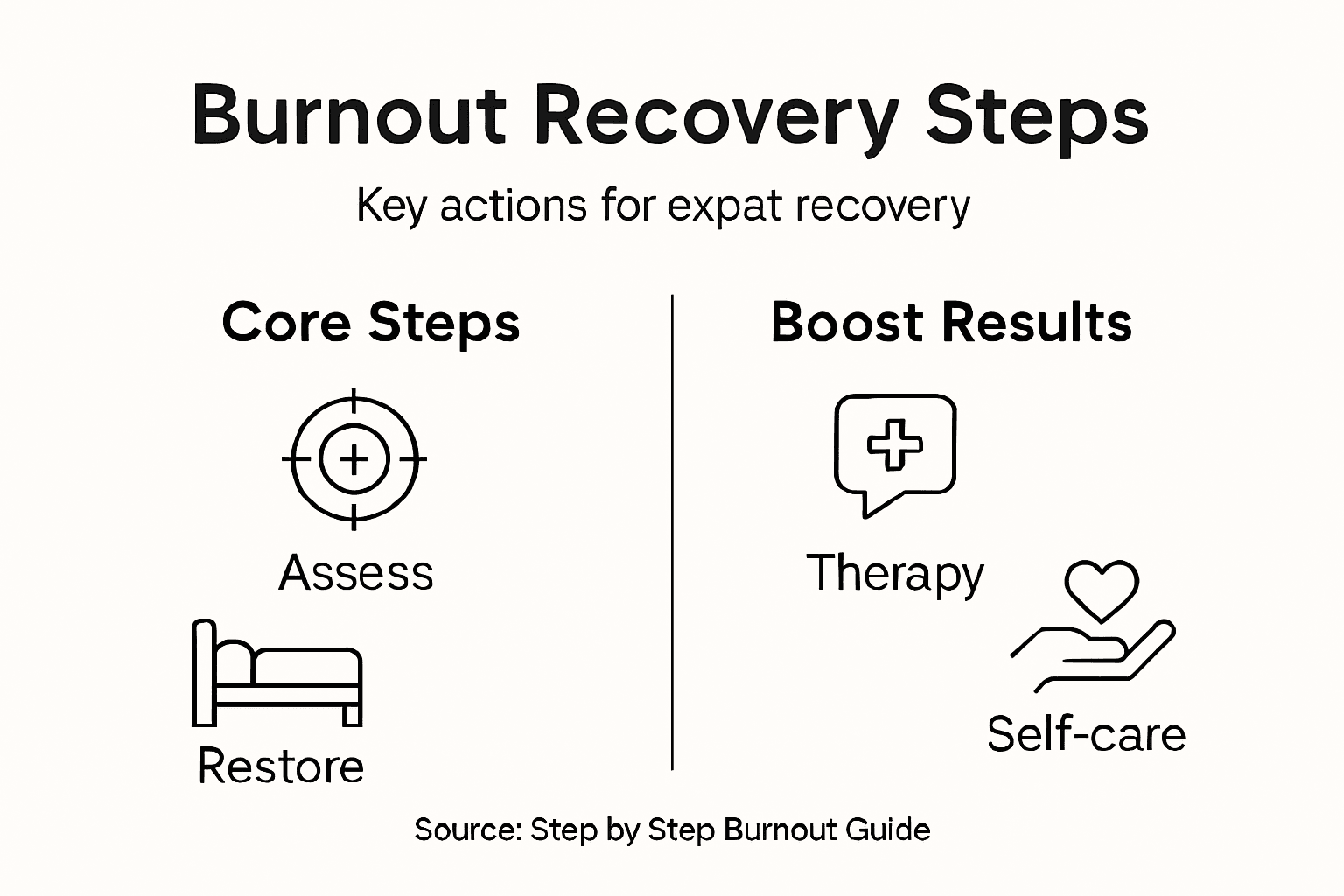
1. Identify Burnout Symptoms | Assess emotional exhaustion, detachment, and physical signs to understand your burnout clearly. Track your mood and energy levels for a week to identify triggers. |
2. Establish Daily Routines | Create small, restorative daily practices to reset your nervous system, such as morning rituals, midday breaks, and evening wind-downs to foster recovery. |
3. Integrate Therapy for Recovery | Use a combination of therapeutic methods for effective burnout recovery. Tailor approaches like Rapid Transformational Therapy and Cognitive Behavioral Therapy to your needs. |
4. Prioritize Self-Care Practices | Actively structure self-care across cognitive, emotional, physical, and spiritual areas to replenish your energy and prevent relapse into burnout. |
5. Monitor Recovery Progress | Regularly track your recovery metrics like emotional exhaustion and cynicism to ensure you adjust your plan effectively and sustain improvements over time. |
Step 1: Assess burnout symptoms and triggers
You’re about to conduct a personal inventory of what burnout actually looks like in your life. This step is foundational because you can’t recover from something you haven’t clearly identified. Many expats in Madrid push through exhaustion without recognizing it as burnout, mistaking it for normal stress or cultural adjustment challenges. What you’ll do here is map your physical, emotional, and behavioral patterns to understand whether you’re experiencing burnout and what’s driving it.
Burnout officially involves exhaustion, cynicism, and reduced efficacy, all stemming from chronic workplace stress that hasn’t been managed effectively. Start by examining your current state across three key areas. First, look at emotional exhaustion—this goes beyond normal tiredness. You might feel emotionally depleted after work, drained before you even start your day, or cynical about tasks you once found meaningful. Second, assess your sense of ineffectiveness. You may notice reduced productivity, difficulty concentrating, or feeling like your work doesn’t matter anymore. Third, identify any detachment or cynicism you’ve developed toward your job, colleagues, or work itself.
Next, track your physical and behavioral symptoms. Burnout shows up in your body and actions, not just your mind. Common signs include:
Sleep disruption (falling asleep easily but waking at 3 AM, or insomnia despite exhaustion)
Persistent physical tension, headaches, or gastrointestinal issues
Increased reliance on caffeine, alcohol, or other substances to cope
Withdrawal from social activities or colleagues you once enjoyed
Difficulty making decisions or remembering details
Irritability or emotional outbursts that feel out of proportion
Now pinpoint your specific triggers. Key risk factors include excessive workload, lack of support, and workplace conflict, but your triggers are personal to your situation. As an expat, consider both universal work stressors and expat-specific pressures. Do certain meetings drain you completely? Does your workload spike at particular times? Is there tension with specific colleagues or a lack of understanding about your expat experience? Does the cultural adjustment demand constant emotional labor? Document these patterns by tracking your mood and energy levels for one week. Write down what happened before you felt particularly exhausted or cynical.
Your triggers reveal what’s actually driving your burnout—this knowledge becomes your leverage point for meaningful recovery.
One crucial distinction matters here: burnout can overlap with anxiety and depression, so careful evaluation of your specific symptoms guides you toward the right recovery approach. Some days you might feel depressed, other days anxious, but the consistent thread in burnout is that work-related exhaustion and detachment remain present even on your better days.
Pro tip: Use a simple three-column notebook or phone notes app to track your daily energy level (1-10), what happened at work, and your emotional state for seven days straight—this data becomes invaluable when discussing your situation with a therapist and reveals patterns you’d otherwise miss.
Step 2: Establish restorative daily routines
You’re going to build a framework that resets your nervous system consistently, giving your body and mind concrete signals that recovery is happening. This isn’t about overhauling your entire life—it’s about weaving small, restorative practices into the hours you already live. When you’re burned out, your nervous system stays stuck in high alert. These micro-recovery techniques interrupt that pattern and create the biological conditions for genuine healing.

Start your day with a morning grounding ritual that engages your senses before stress begins. This takes less than ten minutes. When you wake, before checking your phone or email, do something that anchors you to the present moment. Some expats in Madrid find success with a cold shower that wakes the senses, others with five minutes of sitting by a window with coffee while noticing what they see, hear, and feel around them. The key is engaging your nervous system in something calming rather than immediately loading it with work demands. This morning mindset shift helps ground your senses and sets a different tone for your entire day.
During your workday, inject midday energy discharge. Around lunch or mid-afternoon, do something physical for ten to fifteen minutes. This doesn’t mean joining a gym or committing to an intense workout. Walk outside for a short loop, do some stretching at your desk, climb stairs deliberately, or find a quiet corner for breathing exercises. What matters is breaking the mental intensity with physical movement. Your burnout accumulated because stress chemicals like cortisol stayed elevated all day without discharge. This midday practice helps manage stress through brief physical activity and breathing exercises, essentially pressing a reset button on your nervous system before the afternoon intensifies.
In the evening, establish clear boundaries that protect your rest. Decide on a specific time when work communication stops. This is non-negotiable. One hour before bed, put your work devices away physically—out of sight in another room if possible. Instead, engage in what genuinely feels restorative to you. Some people journal, others read fiction, meditate, or spend time on hobbies that have nothing to do with their job. The specifics matter less than consistency. Your nervous system learns that rest time is actually protected and coming.
Build these specific routines into your week:
Morning ritual (5-10 minutes) with sensory grounding before work begins
Midday break (10-15 minutes) with movement or breathing to discharge stress
Evening wind-down (30-60 minutes) with work devices removed and restorative activities
At least two days where you protect one full evening without work thoughts
Weekend time blocked off where you genuinely step away from work demands
Small, consistent practices reset your nervous system more effectively than occasional grand gestures—burnout recovery happens in the daily micro-decisions, not the vacation week.
The reason these routines work is they’re sustainable and specific. You’re not trying to transform into a different person. You’re simply creating space where your body can experience safety and recovery. Many expats struggle because they add guilt about not doing enough self-care on top of their burnout. This approach removes that burden. These routines take less than thirty minutes daily combined, yet they create measurable shifts in your energy, sleep, and emotional baseline within two weeks.
As you establish these routines, stocking up on nourishing foods for sustained energy matters as well. Burnout makes you reach for quick fixes—coffee, sugar, processed foods. Instead, have accessible healthy options: nuts, fruit, yogurt, hummus, vegetables already cut. Your nervous system recovery depends partly on stable blood sugar and proper nutrition, not just what you do but what you fuel your body with.
Here’s a breakdown of how daily restorative routines can impact burnout recovery:
Routine Type | Main Purpose | Biological Impact | Long-Term Benefit |
Morning grounding | Stabilizes mood before stress | Calms nervous system | Improves daily resilience |
Midday energy break | Releases accumulated tension | Reduces cortisol levels | Sustains afternoon energy |
Evening wind-down | Signals time for rest | Enhances sleep quality | Restores emotional balance |
Protected evenings | Disconnects from work completely | Lowers stress hormones | Prevents burnout relapse |
Nourishing foods | Fuels sustained energy | Stabilizes blood sugar | Supports physical recovery |
Pro tip: Set phone reminders for your three daily routines (morning ritual, midday break, evening wind-down) and schedule them in your calendar like non-negotiable meetings—treating recovery time as seriously as you treat work commitments makes it actually happen instead of getting abandoned when stress increases.
Step 3: Integrate therapy methods for rapid relief
This is where your recovery accelerates. You’ve assessed what’s happening and built daily routines that stabilize your nervous system. Now you’re going to layer in professional therapeutic approaches specifically designed to address burnout at its root. The right therapy combination doesn’t just manage symptoms—it rewires the patterns that created your burnout in the first place, delivering measurable relief in weeks rather than months.
Understand that there’s no single “best” therapy for burnout. Your brain responds differently than someone else’s, and what works brilliantly for your colleague might not resonate with you. That’s why combining therapy methods accelerates your recovery by addressing burnout from multiple angles simultaneously. At Heske Therapy, the integrative approach blends several evidence-based methods into a personalized plan. Rapid Transformational Therapy (RTT) identifies the root beliefs driving your burnout—often unconscious patterns formed years ago—and rewires them at the neurological level. This produces shifts in how you perceive work stress and your own capabilities. Cognitive Behavioral Therapy (CBT) helps you recognize thought patterns that amplify exhaustion and teaches concrete techniques to interrupt them. EMDR processes traumatic or deeply stressful work experiences that your nervous system still treats as active threats. Hypnotherapy works with your subconscious to establish new neural pathways supporting resilience and calm.
The research is clear: psychological approaches including mindfulness, cognitive-behavioral therapy, and compassion-focused therapies deliver rapid burnout relief. Beyond traditional talk therapy, art therapy produces significant improvements when integrated into recovery programs, and bi-weekly sessions show measurable results. As an expat in Madrid, you benefit from having access to these multiple modalities in one place rather than juggling different practitioners.
To help clarify therapy choices, here is a comparison of evidence-based burnout therapies and their primary advantages:
Therapy Method | Focus Area | Typical Benefit | Best For |
Rapid Transformational | Rewiring root beliefs | Rapid shifts in mindset | Deep-seated stress |
Cognitive Behavioral | Thought patterns | Concrete coping tools | Everyday exhaustion |
EMDR | Trauma processing | Reduces triggers | Work-related trauma |
Hypnotherapy | Subconscious behaviors | Supports calm, resilience | Stress regulation |
Art Therapy | Creative expression | Emotional release | Emotional overload |
Here’s how to approach integrating therapy into your recovery:
Schedule a discovery call with a therapist who specializes in burnout and expat experiences. This isn’t committing to long-term treatment—it’s an assessment conversation where they understand your specific situation and recommend an integrated approach tailored to you.
Identify which therapy methods align with how your brain learns best. Some people respond dramatically to RTT’s direct work with beliefs. Others find CBT’s structure and concrete tools immediately helpful. Some need EMDR to process work trauma. Discuss this openly with your therapist.
Start with two weekly sessions for the first month. This frequency allows your nervous system to consolidate changes between sessions while momentum builds. Many people see meaningful shifts within 3-4 weeks when therapy is combined with your daily routines.
Between sessions, actively apply what you’re learning. If your therapist teaches a breathing technique or a reframe for a work trigger, use it daily. Therapy works best when it’s not confined to the therapist’s office.
The reason therapy accelerates recovery is it addresses what your daily routines alone cannot: the deep patterns, beliefs, and nervous system dysregulation that sustain burnout. Your morning grounding ritual helps stabilize your nervous system. Therapy rewires why your nervous system got stuck in burnout activation in the first place.
Multi-dimensional strategies that combine professional therapy with the lifestyle changes you’ve already started produce dramatically better outcomes than either approach alone.
Many expats hesitate to seek therapy because they worry it means admitting defeat or that they’re “too broken.” This misunderstands what therapy is. You wouldn’t hesitate to see a physical therapist for a shoulder injury. Burnout is a nervous system and belief system injury. Therapy is the professional tool that heals it. You’ve already done the hardest part by acknowledging the problem and beginning recovery work. Adding therapy simply accelerates what’s already in motion.
Expect your first sessions to focus on understanding your burnout history—when it started, what triggered it, what you’ve already tried. This isn’t wasting time. This information allows your therapist to create a targeted approach rather than generic techniques. By session three or four, you should notice shifts in how you experience work situations that previously drained you completely.
Pro tip: Schedule your therapy sessions at a consistent day and time each week, ideally early morning or right after work ends, so it becomes a non-negotiable part of your week rather than something you reschedule when work gets busy—consistency is what allows the therapeutic work to compound into lasting change.
Step 4: Implement supportive self-care practices
You’re moving beyond basic recovery maintenance into active self-care that reinforces your healing and builds lasting resilience. This step transforms self-care from something that sounds nice in theory into a structured practice that directly counters burnout’s effects. Self-care isn’t selfish or indulgent when you’re recovering from burnout—it’s medicine. It addresses the depletion at the heart of your exhaustion and prevents relapse once you’ve started feeling better.
The challenge with self-care for expats in Madrid is that it often gets vague. People say “practice self-care” without explaining what that actually means or why it matters. Self-care encompasses cognitive, emotional, physical, and spiritual domains, which means you’re not just getting a massage or taking a yoga class. You’re deliberately nourishing yourself across multiple aspects of your being. Your cognitive domain needs mental stimulation that isn’t work-related. Your emotional domain needs genuine connection and expression. Your physical domain needs movement and rest. Your spiritual domain needs meaning and alignment with your values.
Start by identifying what depletes you most severely right now. Is it constant social interaction with colleagues draining your emotional reserves? Is it sitting all day without physical activity exhausting your body? Is it feeling disconnected from your values because work dominates your life? Is it isolation from your home culture wearing on you spiritually? Your biggest depletion area gets priority in your self-care plan. If you’re emotionally exhausted, adding more social obligations won’t help you. If you’re physically depleted, meditation alone won’t restore you.
Build self-care practices into your week with the same commitment you’d give a work project. Leisure activities, exercise, mindfulness, social connections, and boundary setting are vital for preventing and mitigating burnout. Notice this list includes both active practices (exercise, leisure, social connection) and protective practices (mindfulness, boundaries). You need both. Here’s how to structure it:
Physical self-care (choose 2-3 per week): walks in Retiro Park, swimming, dancing to music you love, cooking a meal slowly, stretching, anything that makes your body feel alive and capable
Emotional self-care (choose 2-3 per week): conversations with friends where you’re genuinely seen, journaling, crying if you need to, creative expression like writing or music
Cognitive self-care (choose 2-3 per week): reading fiction unrelated to work, learning something that interests you purely, problem-solving puzzles or games, exploring a hobby
Spiritual self-care (choose 2-3 per week): time in nature, practices aligned with your beliefs, volunteering or helping others, reflection on what matters to you
The specifics depend entirely on you, but the structure matters. Don’t try to do everything at once. Pick one thing from each domain and commit to it for two weeks, then adjust. What feels restorative to you is the only measure that matters. Someone else’s self-care routine will fail if it’s not aligned with what actually restores you.
One critical piece: your self-care can’t depend entirely on willpower or motivation. You’re burned out. Your motivation is depleted. Instead, design your environment to make self-care automatic. If you intend to exercise but dread driving to a gym, sign up for a class that starts at a specific time so you go because it’s on your calendar, not because you feel like it. If you want to journal but always forget, leave your journal on your pillow so it’s impossible to miss. If you want to spend time in nature, schedule a specific day each week to go to a park. Remove the decision-making burden.
Self-care is not compensation for bad work situations—it’s the foundation that allows you to recover while you make longer-term changes to your work environment.
Many expats feel guilty implementing self-care because they view it as taking time away from responsibilities. This inverts the actual relationship. Burnout makes you less capable, less present, less effective. Self-care restores your capacity. You’re not choosing self-care over your work. You’re choosing self-care so you can show up to work as a functional human rather than an exhausted shell. Your partner, friends, and colleagues all benefit when you’re restored.
Expect the first few weeks to feel uncomfortable. You might feel selfish or anxious about time away from work. This is the burnout talking. It’s the fear and depletion trying to keep you locked in patterns that created the burnout in the first place. Push through this initial resistance. By week three of consistent self-care, you’ll notice shifts in your sleep, mood, and capacity. By week six, people will comment that you seem different.
Pro tip: Schedule your self-care activities in your calendar with the same non-negotiable status as work meetings, and tell at least one person what you’re doing so you have external accountability when the impulse to cancel comes up—external commitment overrides the internal doubt that burnout generates.
Step 5: Monitor progress and adjust recovery plan
You’re now entering the phase where you track what’s working and refine your approach based on real data rather than intuition. This step separates genuine recovery from the illusion of progress. When you’re burned out, your mind plays tricks on you. You might feel slightly better one day and convince yourself you’re fine, only to crash the next week. Objective measurement cuts through this noise and shows you patterns you’d otherwise miss.
Regularly monitoring recovery progress through objective measures counters cognitive biases that can obscure real improvement under stress. This doesn’t require complicated systems. You’re going to establish a simple baseline, then track the same metrics every two weeks to see what’s actually shifting. The metrics matter because burnout involves exhaustion, cynicism, and reduced efficacy—these are measurable.
First, establish your baseline measurement. Go back to that three-column tracking you started in Step 1 where you noted daily energy levels, what happened at work, and your emotional state. Use this data to score yourself on three dimensions. On a scale of one to ten, rate your current emotional exhaustion (how depleted do you feel by end of day?), your cynicism about work (how negative are you about your job?), and your sense of efficacy (how much do you feel your work matters and that you’re capable?). Write these three numbers down. This is your baseline. You’re not trying to be accurate to decimal points. You’re establishing the general territory so you can track movement.
Now commit to measuring every two weeks on the same day and time. Set a phone reminder for this. Every other Friday evening works well because you can reflect on the past two weeks with fresh perspective. Answer the same three questions again. Are you noticing shifts in exhaustion levels? Is your cynicism softening or intensifying? Does your work feel more meaningful? You’re looking for directional movement, not perfection. Real recovery shows up as small, consistent improvements punctuated by occasional plateaus or small dips. This is normal.
Beyond these core metrics, track practical indicators that show recovery in daily life:
Sleep quality and consistency (falling asleep easily, staying asleep, waking refreshed)
Energy levels at different times of day (morning energy versus afternoon crashes)
Stress responses (how quickly you recover from frustrating situations)
Social capacity (interest in time with friends or colleagues versus withdrawal)
Work engagement (finding moments where work feels purposeful versus constant dread)
Physical symptoms (tension, headaches, digestive issues improving or persisting)
After four weeks of data, you’ll have enough information to identify what’s actually working in your recovery plan and what needs adjustment. Maybe your morning grounding ritual has transformed your sleep, but your evening wind-down isn’t sticking. Maybe therapy is producing shifts in cynicism, but you’re still physically exhausted. Maybe your self-care practices feel sustainable, but you need to adjust your work boundaries. The data tells you where to focus.
When adjusting your plan, change one thing at a time and track its impact. If your exhaustion isn’t improving despite therapy and self-care, maybe you need to address a specific work situation directly—perhaps renegotiating responsibilities or having a conversation with your manager about workload. If cynicism persists, your therapy approach might need deepening or shifting. If physical symptoms linger, you might need more consistent movement or medical evaluation. Data-driven adjustment beats guessing.
Progress in burnout recovery rarely looks like steady upward lines—it looks like gradual improvement with plateaus and occasional dips, and that’s exactly what sustainable recovery should look like.
Expat-specific factors matter in your monitoring. Are you noticing shifts in your capacity to handle the cultural demands of living in Madrid? Is your emotional energy for connection improving? Are you withdrawing less from your expat community or engaging more? These aren’t generic burnout metrics, but they indicate whether your recovery supports your life as an expat, not just your work life.
As your recovery advances beyond the first two months, space your monitoring out to monthly check-ins. You’re no longer in crisis mode. You’re in consolidation mode where you’re cementing the changes and monitoring for relapse. By six months, you should see marked improvements across all metrics. Energy levels stabilized. Cynicism replaced by realistic engagement. A genuine sense that your work has value and you’re capable of doing it. These shifts are what recovery actually looks like.
Pro tip: Keep your biweekly scores in a simple spreadsheet or even a notes app with dates, then look at the trend across eight to twelve weeks rather than obsessing over individual scores—trends reveal patterns that single data points obscure, and watching the overall line move upward becomes motivating when you hit difficult weeks.
Take Control of Your Burnout Recovery with Expert Support
If you are an expat struggling with exhaustion, cynicism, or feeling ineffective at work as described in the “Step by Step Burnout Recovery Guide for Expats” you are not alone. The guide highlights how burnout can deeply affect your emotional and physical well-being and stresses the importance of identifying triggers, establishing restorative routines, and integrating professional therapy. At Heske Therapy we specialize in helping English-speaking expatriates in Madrid overcome burnout through personalized, evidence-based approaches such as Rapid Transformational Therapy, EMDR, and CBT. Our tailored treatment plans address the root causes of burnout while supporting your daily recovery practices to deliver rapid and lasting relief.
You deserve to restore your energy, rebuild your resilience, and reclaim your sense of purpose at work and in life. Heske Therapy offers both online and in-office sessions designed specifically for expats facing the unique pressures of living abroad. By combining your self-care routines with expert guidance and integrative therapy methods you can break free from the cycle of burnout and rediscover balance.
Ready to leave burnout behind and move toward meaningful recovery? Start your journey today by scheduling a free discovery call at Heske Therapy. Learn how our integrative therapies and compassionate approach can support your healing every step of the way. Explore more about our specialized services that address anxiety, trauma, sleep issues, and emotional blocks to complement your burnout recovery at Heske Therapy. Take this essential step now and invest in your mental wellness and future happiness.
Frequently Asked Questions
What are the initial signs of burnout I should look for?
Burnout typically presents as emotional exhaustion, a sense of ineffectiveness, and increased cynicism towards work. Assess your feelings after work and daily productivity levels to identify these signs, and start tracking your symptoms for a week to understand your experiences better.
How can I create daily routines to help with burnout recovery?
Establish a morning grounding ritual, a midday energy break, and a strict evening wind-down to support your recovery process. For example, spend 5-10 minutes each morning engaging your senses before starting work, and commit to at least 30 minutes each evening away from work devices.
What therapy methods are most effective for treating burnout?
Combining different therapy methods such as Rapid Transformational Therapy (RTT), Cognitive Behavioral Therapy (CBT), and Eye Movement Desensitization and Reprocessing (EMDR) can provide rapid relief from burnout symptoms. Schedule an initial consultation to discuss a personalized plan that works best for you, focusing on methods that resonate with your experiences.
How often should I monitor my recovery progress?
Regularly track your recovery metrics every two weeks to gauge improvement in emotional exhaustion, cynicism, and sense of efficacy. Set a routine to evaluate your progress in a consistent manner on the same day every two weeks, aiming to identify tangible changes over time.
What self-care practices should I include in my routine to combat burnout?
Incorporate physical, emotional, cognitive, and spiritual self-care activities into your weekly routine. Aim for at least two practices from each category, such as going for walks, engaging in conversations with friends, reading fiction, or spending time in nature, consolidating these activities into your schedule to ensure regular participation.
What should I do if my burnout symptoms persist despite self-care and therapy?
If your burnout symptoms continue despite implementing self-care and therapy, consider adjusting your workload or seeking additional support in your work environment. Prioritize open communication with your supervisor or colleagues about your challenges and look for strategies to manage your responsibilities more effectively.
Recommended
Comments